 blog
Best Deck Lighting Ideas for Small Spaces
Table of Contents
- Why Deck Lighting Matters More on a Small Deck
- Small Deck Lighting Ideas That Save Floor Space
- Low-Voltage Deck Lighting: The Flexible Backbone
- Solar Deck Lights for a No-Wiring Setup
- Deck Stair Lighting for Safety and Visibility
- Brightness, Color Temperature, and Neighbor-Friendly Design
- How to Plan a Lighting Layout for a Compact Deck
- Conclusion
- Frequently Asked Questions
Last Updated: October 17, 2026
Why Deck Lighting Matters More on a Small Deck
A small deck has no room for wasted light. Every fixture either earns its space or crowds the railing, so the best deck lighting ideas for small spaces start with restraint, not wattage.
The core tension: a small deck needs layered light but has almost no surface to mount layers on.
Deck lighting is the practice of mounting fixtures on railings, posts, steps, and nearby walls to provide safety, visibility, and atmosphere after dark.
That definition matters because it changes what you shop for. The U.S. Department of Energy's outdoor lighting guidance makes the same point about control and placement over raw output.
Small Deck Lighting Ideas That Save Floor Space
Space-saving deck lighting moves fixtures up and out. Wall-mounted lights, post cap lights, and rail fixtures keep the walking surface clear on a deck that barely fits a grill and two chairs.
Start with the four fixture families that take up zero floor space:
- Post cap lights that replace the flat cap on a 4x4 or 6x6 post
- Wall-mounted sconces on the house side of the deck
- Under-rail LED strips tucked behind the top rail
- Recessed inset lights set flush into rail posts or fascia
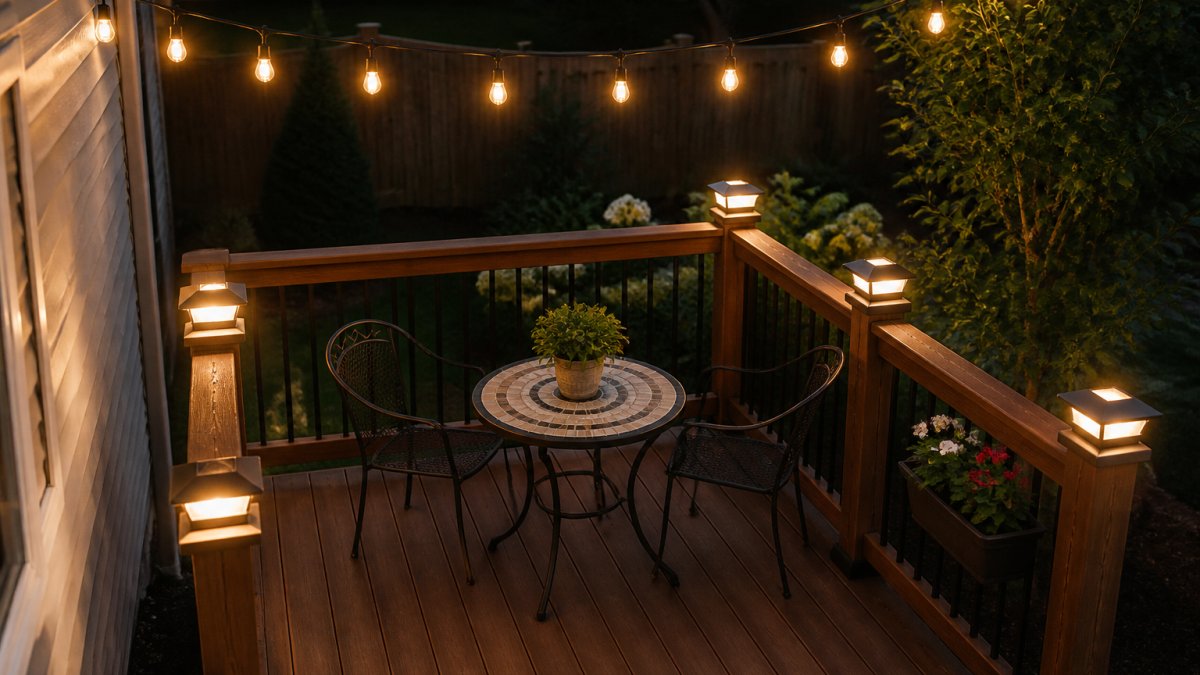
Wall-Mounted and Post Cap Lights
Post cap lights are the best upgrade for a compact deck: they sit where the post already is, throw light down onto the rail and floor, and add no clutter. Wall-mounted fixtures handle the house side, where a sconce washes the whole deck without a floor fixture. A common mistake is buying post caps that are too bright, glare bounces off the railing and blinds anyone seated nearby.
Rail, Under-Rail, and Inset Lights
Rail lighting splits into three styles, and each fits a different deck:
- Top-rail lights sit on the rail and cast a soft pool downward
- Under-rail LED strip lights hide completely and create an even glow
- Inset lights recess into the rail face for a clean, built-in look
Under-rail strips are the space-saving champion. They disappear into the structure, so a small deck keeps its clean lines while the floor gets an even wash of light.
Low-Voltage Deck Lighting: The Flexible Backbone
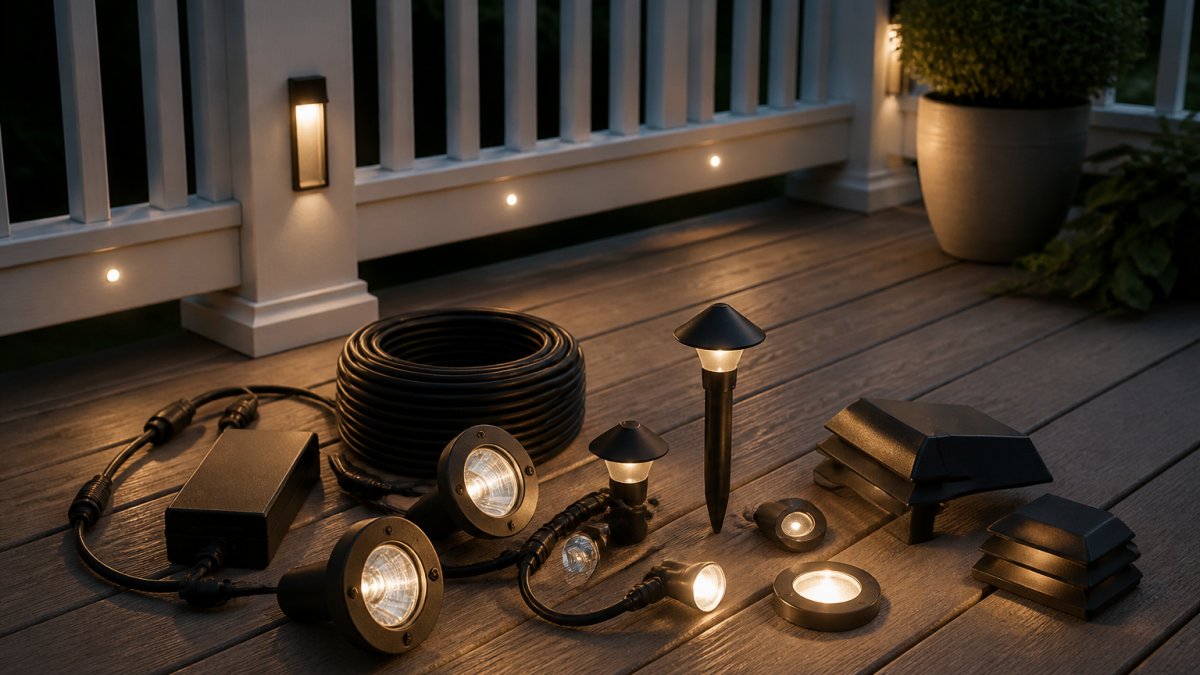
Low-voltage deck lighting runs on 12 volts through a transformer plugged into a standard outdoor outlet. It is the most flexible backbone for a small deck because thin cable routes along rails and posts without bulky conduit.
The system has four parts:
| Component | What It Does | Why It Matters on a Small Deck |
|---|---|---|
| Transformer | Steps 120V house power down to 12V | One unit can power every fixture |
| Main cable | Carries low-voltage power | Thin, easy to hide along rails |
| Fixtures | Post caps, strips, step lights | Small, low-profile options |
| Connectors | Tap fixtures into the cable | Add or move lights later |
Low-voltage systems suit compact decks because you can add a fixture without rewiring the house: tap the cable and go.
Solar Deck Lights for a No-Wiring Setup
Solar deck lights run on a small panel and battery, no transformer, cable, or outlet.
The trade-off is output: solar fixtures produce less light than wired low-voltage systems and depend on direct sun.
Where solar wins on a small deck:
- Post caps on a sunny, south-facing rail
- Step lights where running cable is awkward
- Path or stair markers near the deck edge
Pair solar with a wired system if you want both reliability and zero-wiring convenience. Many homeowners use low-voltage for the main layer and solar for accent pieces.
Deck Stair Lighting for Safety and Visibility
Deck stair lighting is the safety layer, and the one place a small deck deserves real attention. Steps are where people fall, especially guests unfamiliar with the layout and older family members navigating after dark.
Three approaches work well:
- Recessed riser lights set into the stair riser, casting light down onto each tread
- Post-mounted step lights on the newel posts at the top and bottom
- LED strip under the stair nosing for a continuous glow along the run
For aging-in-place households, stair lighting is not decorative. Pioneer Woodwerx builds aging-in-place modifications into deck projects across Middlesex and Monmouth Counties, and stair lighting is one of the simplest safety upgrades a deck can carry.
Brightness, Color Temperature, and Neighbor-Friendly Design
Brightness and color temperature decide whether a small deck feels inviting or looks like a parking lot.
Color temperature is the warmth or coolness of white light, measured in kelvin (K).
Brightness is measured in lumens, and small decks need far fewer than people buy. A practical starting point for a compact deck:
- Post cap and rail lights: roughly 30 to 80 lumens each, dimmable
- Step and stair lights: roughly 15 to 40 lumens per tread, aimed down
- Under-rail strip: roughly 100 to 200 lumens per linear foot of run, on a dimmer
These are starting ranges, not rules.
Beam spread is the angle of light a fixture throws.
Neighbor-friendly design is where small lots get tricky. Light crossing the property line is the top complaint on tight suburban lots.
The International Dark-Sky Association's outdoor lighting guidance recommends shielded, downward-directed fixtures with warm color temperatures for exactly this reason, the same principles that keep a small deck polite to the neighborhood also make it more comfortable to sit on.
How to Plan a Lighting Layout for a Compact Deck
A lighting layout for a compact deck comes down to four zones: the house wall, the rails, the steps, and the deck edge. Plan each with real measurements before buying a fixture, because spacing makes a small-deck plan read as intentional rather than scattered.
Here is the measured process we would use on a small Old Bridge deck:
- Measure the deck and sketch the rail length, post spacing, and stair run. Note the distance from the house wall to the far rail.
- Mark the zones on the sketch, one color per layer: wall, rail, steps, edge.
- Count posts for post cap lights, and note which face the house and which face the yard.
- Trace the cable route from the transformer to the farthest fixture, keeping the run as short as the layout allows.
- Set brightness targets per zone, keeping ambient low and safety lights aimed down.
- Test at night with temporary lights before committing to fixtures.
That last step saves the most money. A dry run with a few battery-powered lights shows where glare hits and where shadows fall before anything is mounted.
Spacing and Fixture Counts for a Compact Deck
Spacing is where most small-deck plans go wrong. The goal is even coverage without a crowded rail; the numbers below are a practical starting point, not a code requirement.
- Post cap lights: one per post. On a typical 10-by-12-foot deck with posts every 6 to 8 feet, that is usually four to six caps. If the rail is short, cap every other post and let the under-rail strip fill the gaps.
- Under-rail strip: run it continuously along the rail that faces the seating area, not the whole perimeter. A single 12- to 16-foot run on the main rail usually lights the deck floor evenly without overlighting the edges.
- Wall sconces: one on the house wall, centered on the seating zone, is often enough on a compact deck. Two only if the wall run is longer than about 12 feet.
A common pattern on a compact deck is four post caps, one 12-foot under-rail run, one wall sconce, and two step lights, eight fixtures, layered so no single one has to be bright.
A Worked Layout for a 10-by-12-Foot Deck
Picture a 10-by-12-foot deck with the house on the long side, rails on the two outer sides, and a 4-foot-wide stair at one corner. A layout that works:
- House wall: one shielded sconce centered on the seating area, roughly 100 to 200 lumens, on a dimmer.
- Long outer rail: four post cap lights, one per post, at roughly 30 to 80 lumens each.
- Short outer rail: one continuous under-rail strip run, roughly 100 to 150 lumens per linear foot, dimmed to about half.
That plan lights every walking surface, keeps the floor clear, and leaves the ambient layer low enough that the deck still feels like a place to sit rather than a stage.
Choosing the Right Fixture for Each Zone
Zone by zone, the fixture choice follows the job:
| Zone | Best Fixture | Why |
|---|---|---|
| House wall | Shielded wall sconce | Washes the deck from above without floor clutter |
| Rails | Post cap lights | Uses the post that is already there |
| Under-rail | LED strip in a channel | Hides completely, even floor wash |
| Steps | Recessed riser lights | Lights the tread, not the eyes |
| Deck edge | Path markers | Marks the boundary without glare |
If you would rather hand the whole plan to a builder, we design and install deck lighting as part of our deck and outdoor living projects. Homeowners searching for deck lighting near me in Old Bridge can review the DOE's lighting design basics and then request a free consultation with our team.
Conclusion
The hardest part of lighting a small deck is not choosing fixtures. It is resisting the urge to over-light a space that only needs a few well-placed layers.
Pioneer Woodwerx builds decks and outdoor living spaces across Central New Jersey with 100% real wood, custom builds to your specifications, and aging-in-place safety details like proper stair lighting.
Get started with Pioneer Woodwerx and request a free consultation for your small deck lighting project.
Frequently Asked Questions
Where should lights go on a small deck?
Start with the spots you actually walk: the stairs, the door landing, and the rail perimeter. Post cap lights and rail lights mark the edges without eating floor space, while step lights handle the stairs. Add one wall-mounted fixture near the door for task lighting, then a single accent light on a planter or feature corner. Keep the layout symmetrical so a compact deck reads as intentional rather than crowded. Aim for soft, layered light rather than one bright source.
Are solar or low-voltage lights better for a small deck?
Solar deck lights install in minutes with no wiring and no transformer, which suits renters and decks far from an outlet. Their output depends on how much sun the spot gets, so shaded decks may dim early. Low-voltage deck lighting runs from a transformer and gives consistent brightness all evening, plus more fixture styles like rail, step, and inset lights. For a small deck with reliable power nearby, low-voltage offers more control; for a quick, no-drill setup, solar is the easier start.
How can you make a small deck feel larger with lighting?
Light the edges, not the middle. Rail lights, post cap lights, and under-rail lighting outline the deck's perimeter, which draws the eye outward and makes the space read bigger. Keep color temperature consistent, around 2700K to 3000K, so the deck feels like one warm room. Avoid a single harsh overhead fixture that shrinks the space with glare. A few well-placed layers, stair lighting plus perimeter glow plus one accent, do more than flooding the whole deck with light.
Are recessed deck lights a good choice for small spaces?
Yes, when placed in the right spots. Inset lights sit flush with the deck boards or risers, so they take up zero floor space and never snag a chair leg. They work best along stair risers, on perimeter boards, and as pathway markers on larger decks. On a compact deck, use them sparingly, since too many flush fixtures can look busy. Pair a few recessed step lights with rail or post cap lights for a clean, layered look that keeps the walking surface clear.