 how-to
How to Identify Solid Wood Furniture: 7 Steps
Table of Contents
- What You'll Need Before You Start
- Step-by-Step: How to Identify Solid Wood Furniture
- Solid Wood vs Veneer Furniture: Key Differences
- How to Spot Particle Board Furniture
- Visual Glossary: Common Wood Grain Types
- Modern Engineered Wood vs. Antique Solid Wood
- Maintenance and Restoration Implications of Solid Wood Furniture
- Benefits of Custom Solid Wood Furniture
- Frequently Asked Questions
Last Updated: August 30, 2026
Knowing how to identify solid wood furniture is the difference between an heirloom piece that lasts generations and a particle board disappointment that warps within two years. At PIONEER WOODWERX, we build every piece from 100% real wood, and we hear the same frustration constantly from homeowners: they paid good money for "wood" furniture, only to discover it was mostly compressed sawdust and synthetic resin. This guide walks you through seven concrete steps to verify solid wood construction before you buy, plus a clear breakdown of what separates genuine hardwood from veneer, MDF, and engineered alternatives.
What You'll Need Before You Start
Identifying solid wood furniture requires no special equipment. Bring a small flashlight (phone flashlight works), your knuckles for the tap test, a fingernail or coin for scratch testing, and a keen eye for grain consistency and joint construction. That's it. No tools or certification required.
One important note: "solid wood" means the piece is constructed from milled lumber throughout, with no core material substitution. Veneer, plywood, MDF, and particle board are not solid wood, regardless of marketing claims.
Step-by-Step: How to Identify Solid Wood Furniture
Solid wood furniture is constructed entirely from natural milled lumber, where the wood grain runs consistently through the full thickness of each component.
Step 1: Check the Wood Grain Pattern
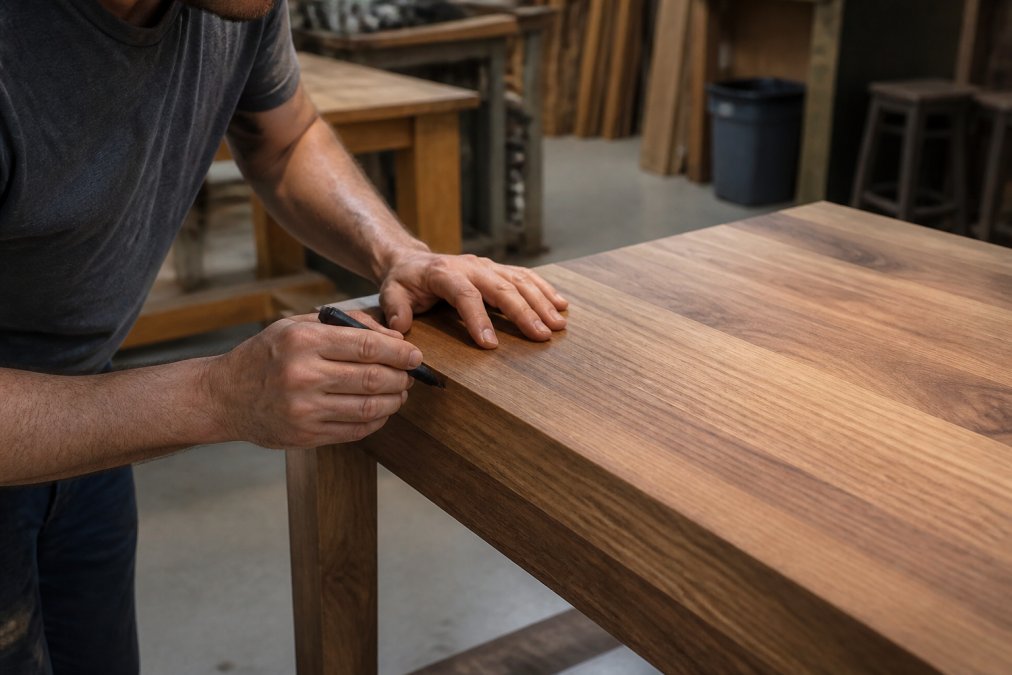
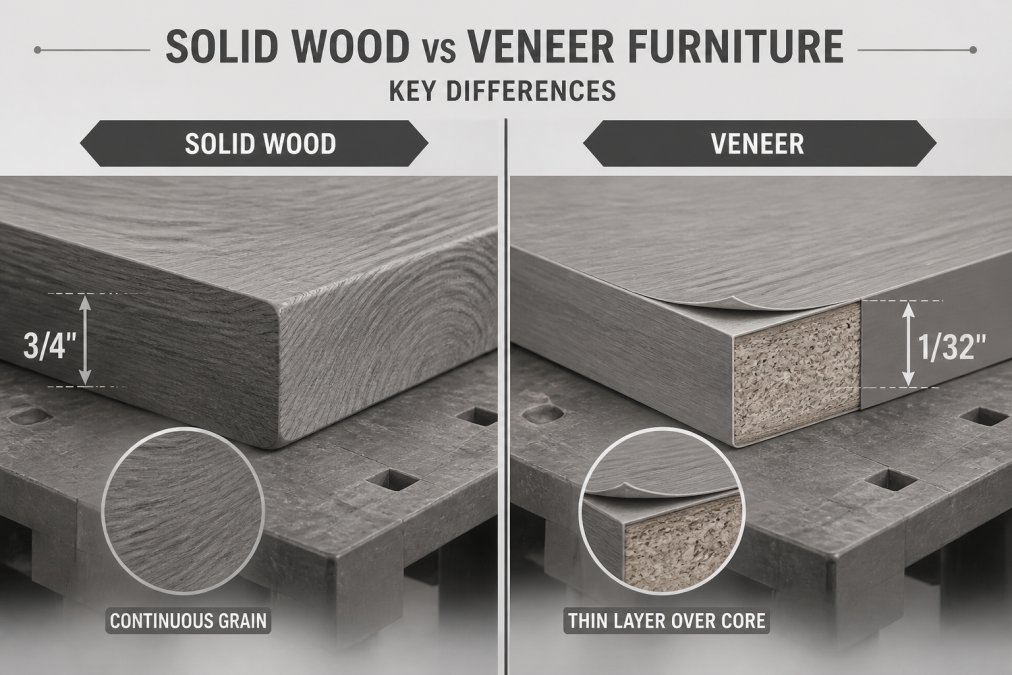
On genuine solid wood, the grain flows continuously from one face of the board through to the edge. Turn the piece so you can see both the top surface and the edge simultaneously. If the grain wraps around the corner in a natural, uninterrupted line, you're looking at solid wood.
Veneer tells a different story. Because veneer is a thin slice bonded over a composite core, the grain stops abruptly at the edge. The edge will show a different material, edge banding, or mismatched grain direction.
Look for grain continuity from face to edge, natural variation (real wood is never perfectly uniform), and wood knots or mineral streaks that extend through the board thickness.
Step 2: Perform the Tap Test
Knock your knuckles firmly on several areas of the furniture surface. Solid wood produces a dense, muted thud. Particle board, MDF, and hollow-core construction produce a hollow sound, almost like knocking on cardboard.
Test multiple spots on the same piece. A dining table might have a solid wood top but particle board sides. The hollow sound reveals exactly which components are engineered wood.
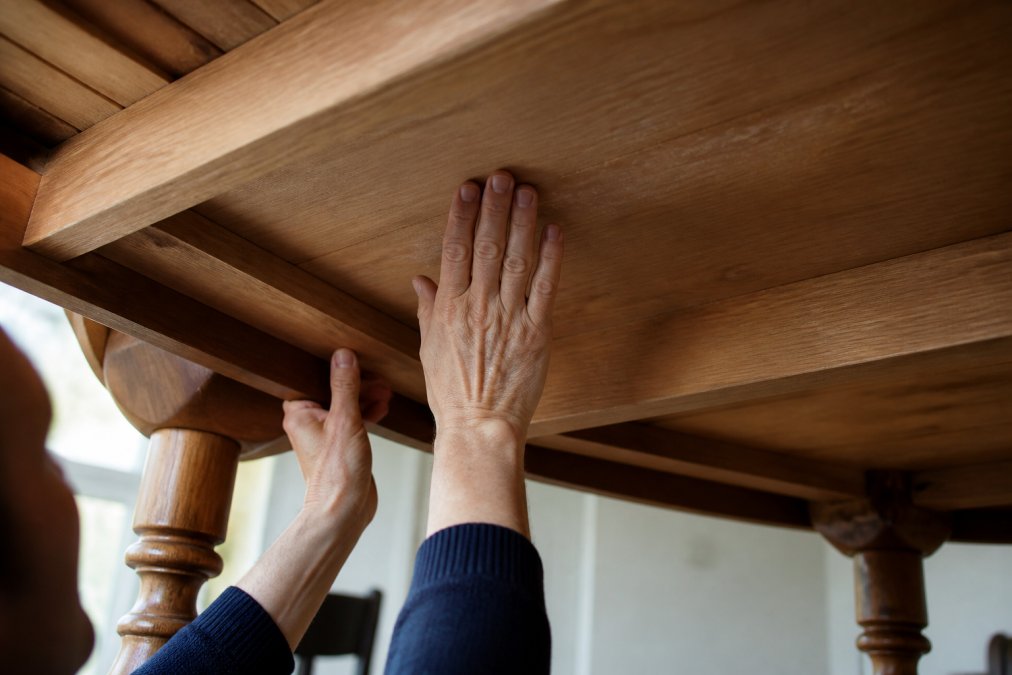
Step 3: Inspect the Underside and Unfinished Areas
Flip the piece over or crouch down and look at the underside. Manufacturers apply finish to visible faces, but unfinished areas reveal the true core material.
On solid wood, the underside shows raw or lightly finished natural wood grain. On particle board or MDF, you'll see a rough, granular texture with no visible grain, compressed wood fibers that look like cardboard, or visible fasteners driven into crumbling edges.
According to the Forest Products Laboratory at the USDA, wood density and fiber structure are among the most reliable indicators of construction quality.
Step 4: Examine the Joints and Construction
The joints reveal more about furniture construction than almost any other feature. Solid wood furniture built for durability uses dovetail joints, mortise-and-tenon connections, and finger joints.
Dovetail joints are the gold standard. The interlocking wedge-shaped cuts visible on drawer corners require precise woodworking and only function in solid wood or high-grade plywood. Particle board crumbles under the mechanical stress.
Mortise-and-tenon joints appear at leg-to-rail connections on tables and chairs. A tight, clean connection with no visible gap indicates quality solid wood construction.
Avoid pieces with staples holding corners, cam-lock fasteners (common in flat-pack furniture), or visible screws driven directly into panel edges (particle board splits along these lines over time).
Step 5: Assess Weight and Density
Solid wood is heavy relative to its size. A solid oak dining chair is substantially heavier than an equivalent chair built from MDF or hollow composite panels. Weight alone isn't definitive, but combined with other steps, it provides useful information. Solid wood furniture feels evenly weighted; composite-core furniture often feels front-heavy or oddly distributed.
Step 6: Run a Tactile and Visual Surface Test
Run your fingertips across the surface. Solid wood has texture reflecting natural grain: subtle ridges, occasional pores, and minor smoothness variations. Even well-finished solid wood retains a faint topographic quality.
Laminate and paper veneer surfaces feel uniformly smooth, sometimes plasticky, and lack the pore structure of real wood. Press your thumbnail lightly into an inconspicuous area. Real wood dents slightly; laminate over MDF either resists or chips.
Look for pore structure visible under the finish, natural color variation within a single board, and surface texture that follows the grain direction.
Step 7: Look for Natural Imperfections
Real wood is imperfect by nature. Solid wood furniture shows wood knots, grain irregularities, color variation between boards, and minor character marks. These are evidence of natural material.
Engineered wood products are deliberately uniform. Particle board and MDF have no grain, no knots, and no natural variation. A perfectly uniform grain pattern on a large surface is actually a red flag. Real trees don't grow that consistently.
Solid Wood vs Veneer Furniture: Key Differences
Veneer furniture uses a thin slice of real wood, often less than 3mm thick, bonded over particle board, MDF, or plywood (awinet.org). The surface looks like solid wood. The structure is not.
| Feature | Solid Wood | Veneer over Composite |
|---|---|---|
| Grain continuity | Wraps around edges | Stops at the edge |
| Repairability | Sand, refinish, restore | Limited; veneer can't be sanded repeatedly |
| Weight | Heavy for its size | Lighter, often uneven |
| Longevity | Decades to generations | 5-15 years typical |
| Cost | Higher upfront | Lower upfront |
| Best for | Heirloom pieces, high-use furniture | Budget furnishing, short-term use |
High-quality plywood with real wood veneer can be structurally sound and visually beautiful. The problem is when veneer over particle board is sold as "wood furniture" without clear disclosure. The core material determines structural integrity, and particle board has almost none once moisture or stress enters the picture.
According to the Architectural Woodwork Standards published by the Architectural Woodwork Institute, veneer thickness and core material specifications directly determine the rated performance and durability of finished wood products.
How to Spot Particle Board Furniture
Particle board is made by compressing wood fibers and sawdust with synthetic resin under heat and pressure. The result is a dense, uniform panel that machines well but has no structural grain and absorbs moisture readily.
The clearest signs of particle board construction:
- Edge exposure looks granular and rough, like compressed sawdust. Edge banding often peels at corners.
- Cam-lock fasteners, the barrel-shaped hardware used in flat-pack assembly, is designed specifically for particle board and MDF.
- Uniform weight feels dense but not heavy like solid hardwood.
- Screw pull-out failure occurs when particle board around screw holes crumbles after repeated assembly and disassembly.
- No visible grain shows only compressed fiber texture.
Visual Glossary: Common Wood Grain Types
Understanding grain patterns helps you identify wood species and confirm you're looking at real wood.
Straight grain runs parallel to the board length. Species like maple and cherry often display it.
Interlocked grain alternates direction in adjacent growth layers, creating a ribbon-like pattern. Mahogany shows this.
Wavy grain produces a rippled or "fiddleback" figure, prized in high-end furniture and musical instruments.
Open grain species like oak and ash have large, visible pores creating pronounced texture.
Closed grain species like maple and cherry have smaller pores and smoother surface texture.
Burl grain comes from irregular growth around a wound or disease. It shows swirling, chaotic patterns with no consistent direction and is uniquely identifiable as real wood.
If a piece is sold as "white oak" but shows a closed, featureless grain, something doesn't add up.
Modern Engineered Wood vs. Antique Solid Wood
Modern engineered wood products have improved significantly. Cross-laminated timber, furniture-grade plywood, and hardwood plywood are structurally capable materials that professional woodworkers use intentionally. This differs meaningfully from particle board or MDF.
Antique solid wood furniture (pre-1950s) was almost universally built from solid lumber because engineered alternatives didn't exist at scale. Dovetail joints, mortise-and-tenon construction, and hand-cut joinery are reliable markers of period pieces. The wood itself will have aged naturally: darkened, slightly shrunk, with patina that no finish replicates.
Modern engineered wood ranges from high-quality furniture-grade plywood (genuinely structural and stable) to low-grade particle board (cheap filler that degrades quickly). The key question is whether the core structural components are solid.
A well-made piece using furniture-grade plywood for panels with solid wood frames, legs, and face frames is a legitimate construction method. A piece using particle board throughout, dressed with paper laminate, is not.
Maintenance and Restoration Implications of Solid Wood Furniture
The case for solid wood furniture becomes clearest when something goes wrong. A scratch, water ring, or gouge, on solid wood, these are fixable. On particle board or thin veneer, they're often permanent.
Solid wood can be:
- Sanded down and refinished multiple times over its lifetime
- Repaired with wood filler, then stained and finished to match
- Disassembled at the joints, re-glued, and reassembled
- Stripped of old finish and completely refinished in a new stain or oil
Particle board and thin veneer cannot:
- Be sanded (veneer is too thin; particle board has no grain)
- Be refinished after the surface laminate is damaged
- Be repaired structurally once swollen from moisture
- Be restored to original condition after significant wear
Solid wood furniture built 50 years ago can be refinished today and last another 50 years. Particle board furniture from five years ago is often landfill-bound after a single water spill.
Benefits of Custom Solid Wood Furniture
The strongest argument for custom solid wood furniture is functional. Off-the-shelf furniture is designed for the median buyer, fitting almost no one's space exactly. Custom solid wood furniture is designed for your specific room, use case, and life.
PIONEER WOODWERX builds every piece to client specifications from 100% real wood. The dining table is sized for your dining room. Built-ins fit your wall exactly. The farmhouse table is proportioned for your family.
Practical benefits include:
- Exact dimensions for your space, eliminating standard sizing compromises
- Wood species selection matched to your aesthetic, durability requirements, and budget
- Construction method appropriate to use, heavier joinery for high-traffic pieces
- Finish customization to match existing furniture or flooring
- Longevity that justifies the investment: a well-built solid wood piece outlasts multiple rounds of mass-market furniture
When every component is solid wood, joined with proper woodworking joinery and finished with durable surface treatment, there's no weak link in the structural chain. Pieces built today with quality joinery and solid lumber can be refinished, repaired, and handed down.
Choosing solid wood furniture is straightforward once you know what to look for. PIONEER WOODWERX, a veteran-owned business, crafts custom pieces from 100% real wood using proper woodworking joinery, no particle board, no paper laminate, no shortcuts. Every build is tailored to your exact specifications, whether you need a farmhouse table sized for Sunday dinners or built-ins that fit your walls precisely. Request a free consultation with PIONEER WOODWERX and get furniture designed to last.
Frequently Asked Questions
What is the difference between solid wood and particle board?
Solid wood is milled from a single piece of timber, giving it continuous grain, natural imperfections, and high structural integrity. Particle board is manufactured by bonding wood fibers and chips together with synthetic resin under pressure. It weighs less, costs less, and is far less durable. Particle board swells and crumbles when exposed to moisture, cannot be refinished, and typically relies on staples or cam-lock fasteners rather than traditional woodworking joints. Solid wood furniture, by contrast, can last generations with proper care.
Does solid wood furniture have a grain pattern on the underside?
Yes, and that is one of the most reliable tests. Flip the piece over or look at any unfinished surface. On solid wood furniture, the grain pattern continues across the entire thickness and appears on the underside, even if it is rougher or unfinished. Veneer furniture will show a different core material, often MDF, plywood, or particle board, on the underside, with the decorative wood layer visible only on the top surface. Matching grain on all sides is a strong indicator of solid wood construction.
How can I tell if wood furniture is valuable?
Value in wood furniture comes from the wood species, construction method, age, and condition. Furniture built with dovetail joints, solid hardwoods like oak, walnut, or cherry, and hand-finished surfaces generally commands higher prices. Check for maker's marks, mortise-and-tenon joints, and consistent grain patterns, signs of quality craftsmanship. Antique solid wood pieces that show natural wear rather than laminate damage are typically more valuable than modern engineered wood furniture, regardless of how new it looks.
Can I refinish veneer furniture the same way I refinish solid wood?
No. Veneer is a very thin layer of real wood, often less than 1.5 millimeters, bonded over a core material. Sanding it aggressively will cut through to the MDF or particle board underneath, which cannot absorb stain or finish properly. Solid wood furniture can be sanded, stained, and refinished multiple times over decades. If furniture restoration or long-term refinishing is a priority, solid wood is the only material that reliably supports it.
This article was written using GrandRanker