 How-to
7 Solid Wood Dining Table Care Steps That Actually Work
Last Updated: November 3, 2026
Quick Summary
To maintain a solid wood dining table, dust it daily with a soft microfiber cloth, wipe up spills after every meal with a barely damp cloth, and deep clean weekly with a mild soap solution. Match your treatment to the finish type, protect the surface from heat and direct sunlight, and keep indoor humidity steady in the 40-50% range.
- Mix roughly a quarter teaspoon of mild dish soap into a quart of warm water for weekly cleaning.
- Reapply furniture oil or hardwax oil every 3-6 months, or when water stops beading.
- Put felt pads on chairs, vases, and lamps, and lift plates instead of sliding them.
- Never set hot pots or pans directly on the wood; always use a trivet or heat pad.
- Spot-test any new product on a hidden area and wait 24 hours before full use.
Table of Contents
- Why Solid Wood Dining Tables Need a Different Care Routine
- What You'll Need Before You Start
- Daily and Weekly Habits: How to Clean a Wood Dining Table
- How to Protect a Wooden Dining Table from Scratches
- How to Protect a Dining Table from Heat and Sunlight
- The Best Treatment for a Wooden Dining Table by Finish Type
- Seasonal Humidity and Climate Care in Central New Jersey
- Schedule a Free Consultation with Pioneer Woodwerx
- Frequently Asked Questions
Why Solid Wood Dining Tables Need a Different Care Routine
A solid wood dining table is a living piece of furniture, and it reacts to the room around it in ways a laminate top never will. Wood takes in and gives off moisture, expands and contracts with the seasons, and shows every scratch and water ring if you treat it like plastic.
The core idea is simple. Solid wood dining table care is the practice of controlling moisture, heat, and abrasion so the wood grain and protective finish stay intact. Get those three things right and the table ages beautifully. Get them wrong and you get warping, water rings, and dull patches.
Most care guides treat wood like any other surface. It isn't. Here's what you need to know before you touch the table.
What You'll Need Before You Start
Gather your supplies first so you're not searching for a cloth with a spill spreading across the table. The right kit is short and cheap.
- Two or three soft microfiber cloths for dusting and wiping
- A mild soap (a few drops of dish soap in warm water)
- A spray bottle for mixing your cleaning solution
- Coasters and heat pads for daily protection
- Felt pads for the base of chairs and decor
- A quality furniture wax or oil matched to your finish
Skip the paper towels. They leave lint in the grain and can micro-scratch a soft finish. Skip the all-purpose spray cleaner too, and we'll explain why below.
Daily and Weekly Habits: How to Clean a Wood Dining Table
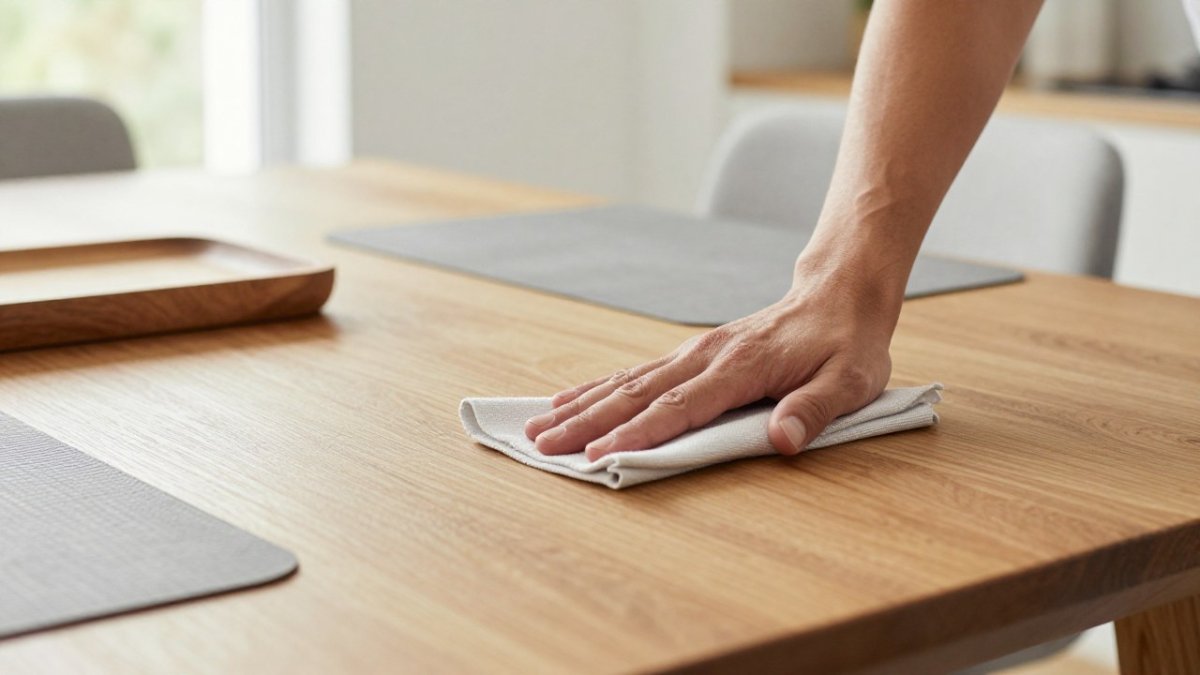
The short answer to how to clean a wood dining table: dust it every day, wipe it after every meal, and deep clean once a week. Daily dusting removes grit that acts like sandpaper under a plate. Wiping after meals stops spills before they set.
What most guides skip is the schedule and the dilution. Here is a practical cadence you can actually keep:
| Frequency | Task | Why It Matters |
|---|---|---|
| Daily | Dry-dust with a soft microfiber cloth, following the grain | Removes grit before it scratches under plates and hands |
| After every meal | Wipe with a barely damp cloth, then dry immediately | Stops spills and crumbs from bonding to the finish |
| Weekly | Mild soap solution wipe-down, then dry | Lifts fingerprints, food film, and light grease |
| Monthly | Inspect edges, seams, and the underside for dulling or lifting finish | Catches wear before it spreads |
| Seasonally | Reassess humidity and reapply finish-specific treatment as needed | Wood moves with the seasons; the finish should keep pace |
The soap solution. Mix a few drops, roughly a quarter teaspoon, of mild dish soap into a quart of warm water in a spray bottle. Mist the cloth, not the table, so you avoid spraying liquid into seams or onto the finish.
Watch out: leaving a wet cloth on the table "to soak" a sticky spot is how water rings form. Lift the spill, dry the area, and let the finish do its job.
Safe Cleaning Solutions and Ingredients to Avoid
A mild soap and water mix handles almost everything. For tougher spots, a wood-safe cleaner labeled for your finish type works fine, but check the label against the finish family, not just the word "wood."
Avoid these entirely:
- Abrasive cleaners and scouring pads, they scratch film finishes and dull oil finishes
- Ammonia-based glass cleaners, ammonia attacks lacquer and dulls polyurethane
- Bleach and disinfecting wipes, they strip oils and can lighten the wood itself
- Silicone-based polishes, they build up over time and make future finish work difficult
- Anything with a strong solvent smell, solvents soften film finishes and lift wax
- Vinegar and water, a popular home remedy, but the acid dulls film finishes with repeated use
The U.S. Environmental Protection Agency's Safer Choice guidance is a useful reference when you are checking what is in a household cleaner before you use it on a finished surface.
Spot-test any new product first. Apply a small amount to a hidden area, wait 24 hours, and check for dulling or tackiness before treating the full table.
How to Protect a Wooden Dining Table from Scratches
The best way to protect a wooden dining table from scratches is to stop grit and hard objects from touching the surface in the first place. Most scratches come from three sources: dust and crumbs dragged under plates, chair legs, and decor that gets slid around.
Here's the routine that works:
- Dust before you wipe. Grit under a cloth is sandpaper.
- Felt pads on everything. Chairs, vases, lamps, the centerpiece bowl.
- Lift, don't slide. Plates, serving dishes, and laptops come up, not across.
- Placemats at every meal. They catch crumbs and soften plate edges.
- Trim pet claws if your dog or cat gets on the table.
A common mistake is using a tablecloth only for holidays. A daily placemat does more for the finish than a cloth that shows up twice a year.
How to Protect a Dining Table from Heat and Sunlight
Protect a dining table from heat by never setting a hot pot, pan, or serving dish directly on the wood. Use heat-resistant placemats, trivets, or a folded towel. Heat softens the finish, and once it softens, a hot dish can leave a permanent white ring or a dull patch.
For sunlight, move the table out of direct rays or close the blinds during peak afternoon hours. UV light fades wood and dries the finish over time. If the table sits in a sunny spot, rotate your decor and consider a window film. A table that fades unevenly is hard to correct later.
- Hot pots and pans: always on a trivet or heat pad
- Serving dishes: heat-resistant placemats underneath
- Direct sunlight: blinds or sheer curtains during the day
- Tablecloths: a good backup for big gatherings
The Best Treatment for a Wooden Dining Table by Finish Type
The best treatment for a wooden dining table depends on the finish, not the wood species alone. Wood and Stain Color Options shows the species and stains a table may have so you can pick the right product.
Finish systems fall into two families. Penetrating finishes, oil, oil-wax blends, and hardwax oil, soak into the wood and leave the grain open to the touch. They need periodic reapplication because the finish wears away rather than chipping. Film finishes, polyurethane, lacquer, conversion varnish, and catalyzed lacquer, sit on top of the wood as a thin plastic-like layer. They need almost nothing beyond cleaning, and adding wax or oil on top of a film finish just builds a sticky layer that traps dust.
Here is how the treatment differs by finish:
| Finish Type | How It Behaves | Best Treatment | Frequency | Avoid |
|---|---|---|---|---|
| Oil or hardwax oil | Soaks into grain; open feel; wears gradually | Reapply furniture oil or hardwax oil, buff in with a cloth | Every 3-6 months, or when water stops beading | Silicone polish, thick wax buildup |
| Oil-wax blend | Semi-penetrating; soft sheen | Thin coat of matching wax, buff out | Every 4-6 months | Harsh degreasers |
| Polyurethane | Film finish; hard, glossy or satin | Damp cloth and mild soap only | Weekly wipe-down | Abrasives, solvents, ammonia |
| Lacquer | Film finish; softer, ages with fine cracks | Soft dry cloth, light wax only if labeled safe | Monthly dust and light wipe | Water rings, ammonia, alcohol |
| Conversion varnish | Film finish; hardest, most chemical-resistant | Damp cloth, occasional wax | Every 6 months | Harsh cleaners, scouring pads |
How to tell which finish you have. Wipe a small hidden spot, the underside of an apron or the edge under the tabletop, with a cloth dampened with denatured alcohol.
Run a spot test before any new product. Choose an inconspicuous area, apply a small amount of the product on a clean cloth, wait 24 hours, and check for dulling, tackiness, or color change.
Watch out: applying a penetrating oil over a polyurethane or lacquer top does not feed the wood, it sits on the film, attracts dust, and can soften the finish underneath.
Not sure what wood you are working with?
Seasonal Humidity and Climate Care in Central New Jersey
Central New Jersey swings hard between humid summers and dry winters, and wood responds to every swing. In summer, indoor humidity climbs and wood swells. In winter, heating dries the air and wood shrinks. That movement is normal, but big swings cause warping and gaps.
A few habits keep the table stable through the year:
- Keep indoor humidity steady, ideally in the 40-50% range
- Run a humidifier in winter and a dehumidifier in summer
- Keep the table away from heating vents and radiators
- Avoid moving the table between rooms with very different conditions
Schedule a Free Consultation with Pioneer Woodwerx
A solid wood dining table rewards a simple routine: dust daily, wipe after meals, protect from heat and sun, and match your treatment to the finish. Do that and the table stays beautiful for decades.
If your table needs professional attention, or you're ready for a new custom hardwood piece built to your specifications, we can help. Our custom tables are built to client specifications, and we build with 100% real wood. As an Army veteran-owned shop, we bring the same discipline to every build.
Ready to talk? Request a free consultation and we'll walk you through options for your home.
Frequently Asked Questions
What can I put on my wood dining table to protect it?
Use coasters under every drink, heat-resistant placemats or pads under hot dishes, and a tablecloth for messy meals. Felt-backed coasters and cork-backed placemats work well because they grip the surface without scratching it. Avoid vinyl or rubber mats directly on wood, since they can trap moisture and discolor the finish over time. For everyday protection, a quality furniture wax or a fresh coat of the original finish adds a sacrificial layer that takes the wear instead of the wood.
How often should I oil a solid wood dining table?
Oil-finished tables usually need a fresh application every three to six months, or whenever the surface starts looking dry and thirsty. Wipe on a thin coat of food-safe oil, let it soak in for 20 to 30 minutes, then buff off the excess with a clean cloth. Tables in dry winter air or near heating vents may need it more often. Never oil a table with a polyurethane, lacquer, or varnish finish, because the oil will sit on top and turn gummy.
Can Murphy's oil soap be used on wood furniture?
Murphy's oil soap is a mild cleaner that many homeowners use on finished wood, but it is not right for every finish. On oil-rubbed or waxed surfaces it can leave a dull film if not buffed out completely. On polyurethane or lacquer, a damp cloth with a drop of mild dish soap is usually safer. Always test a small hidden spot first, and never flood the surface with any liquid cleaner.
How do I clean a solid wood dining table without damaging the finish?
Start by dusting with a soft, dry cloth. For sticky spots, use a barely damp cloth with a drop of mild soap, then dry immediately with a clean towel. Avoid abrasive cleaners, ammonia, bleach, and anything labeled as a degreaser, since these strip the protective finish. Wipe in the direction of the wood grain, and never let water sit on the surface. For a deeper clean, use a cleaner made specifically for the finish type, and test it on an inconspicuous area first.
Your table deserves more than a quick wipe-down. Get started with Pioneer Woodwerx and give your solid wood dining table the care that keeps it in the family for generations.