 ultimate-guide
Custom Furniture Lead Times Explained: 2026 Guide
Table of Contents
- Why Custom Furniture Lead Times Differ From Retail
- Average Lead Time for Custom Wood Furniture
- The Custom Furniture Production Process, Stage by Stage
- What Causes Production Delays and Lead Time Variance
- The Hidden Time: Quality Control and Shipping Buffers
- How to Plan for Custom Furniture Installation
- Frequently Asked Questions
Last Updated: September 14, 2026
Why Custom Furniture Lead Times Differ From Retail
Custom furniture lead times explained simply: a custom piece is built for one household, one set of dimensions, and one finish, so the clock starts at the drawing board rather than the warehouse. Retail furniture is already manufactured, boxed, and sitting in a distribution center. A custom piece does not exist until you order it.
That distinction drives everything. A custom-made dining table has to be specified, milled, assembled, finished, and inspected before it ever reaches a delivery truck. There is no shelf to pull it from.
At PIONEER WOODWERX, we build solid wood furniture to client specifications for families across Central New Jersey, and the single most common question we hear is about timing. Below, we break down the full production schedule, where delays come from, and how to plan a room around a piece that is still being built.
Average Lead Time for Custom Wood Furniture
The average lead time for custom wood furniture typically runs longer than most buyers expect, often stretching across several weeks to a few months depending on complexity (Table of size standards). The honest answer is that lead time is a range, not a fixed number, because it moves with the piece.
Three variables push that range up or down:
- Customization level: A standard-size table with a chosen stain moves faster than a fully bespoke design with unusual dimensions.
- Material sourcing: Solid wood and specialty fabric availability vary by season and supplier.
- Production capacity: A shop with a full schedule adds wait time before your piece even starts.
Typical Timelines by Furniture Type
Different pieces carry different timelines because the work itself differs. A simple bench involves far less frame assembly and finishing than a large upholstered sectional.
| Furniture Type | Relative Lead Time | Main Time Driver |
|---|---|---|
| Solid wood dining table | Moderate | Milling, joinery, finishing |
| Custom shelving or built-ins | Moderate to long | On-site measurement, fit |
| Upholstered seating | Long | Fabric availability, upholstery |
| Bed frames and casegoods | Moderate | Frame assembly, finish curing |
| Small accent pieces | Short | Simple build, minimal finishing |
Use this as a planning guide, not a quote. Your actual delivery window depends on your specific custom specifications.
The Custom Furniture Production Process, Stage by Stage
The custom furniture production process moves through a set sequence, and understanding it is the best way to predict your own timeline. Each stage depends on the one before it, so a slip early on echoes all the way to delivery.
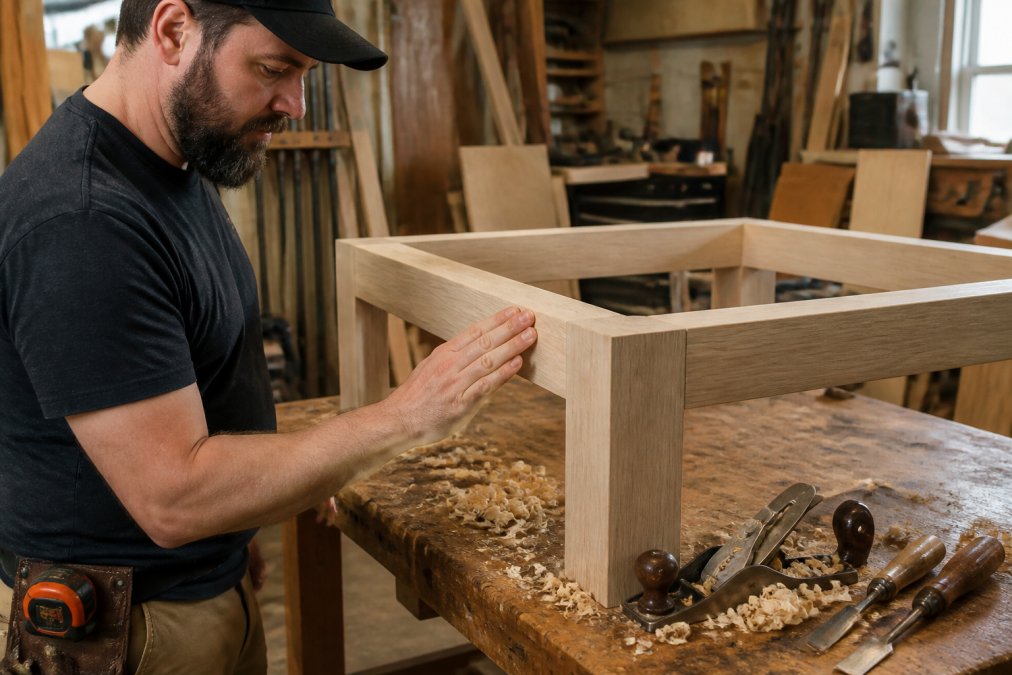
From Raw Materials to Finished Piece
- Consultation and design: You and the builder agree on dimensions, wood species, and finish. This is where custom specifications get locked.
- Material sourcing: Solid wood, hardware, and any upholstery fabric are ordered. Fabric availability can stall this step.
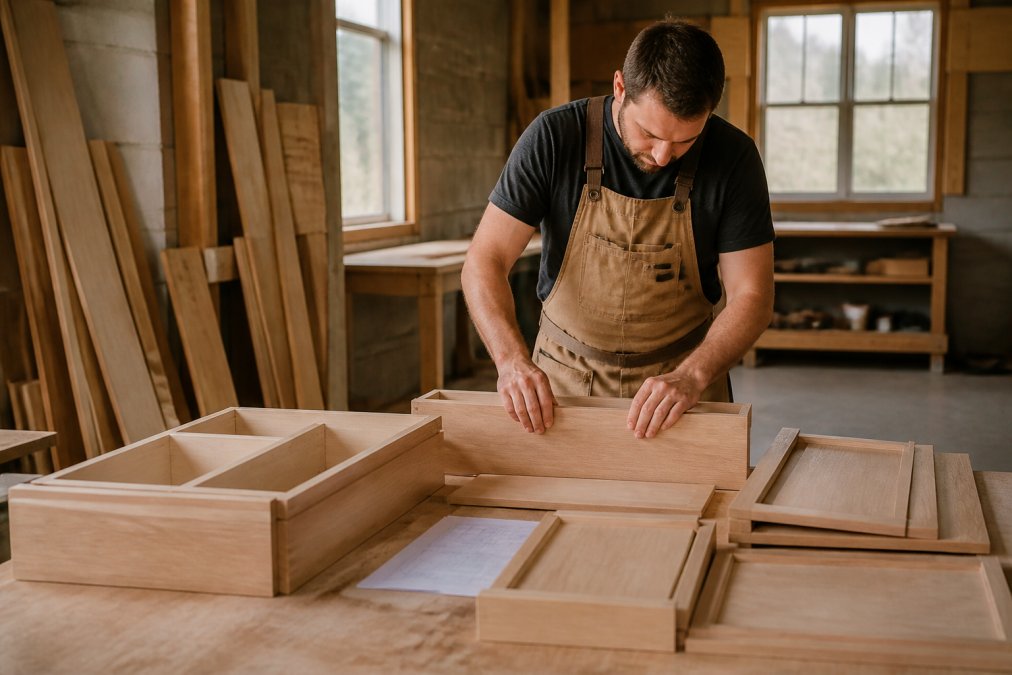
- Milling and cutting: Rough lumber is squared, planed, and cut to size.
- Frame assembly and joinery: The structure comes together. This is the most skill-intensive stage.
- Finishing: Stain, sealant, and topcoat are applied, then left to cure.
- Quality control: The piece is inspected for fit, finish, and stability before it is cleared for shipping.
What Causes Production Delays and Lead Time Variance
Lead time variance comes from a handful of predictable sources, and almost none of them are the builder being slow. Understanding the mechanism behind each one is what separates a buyer who plans well from one who is caught off guard.
Material sourcing and supply chain interruptions. Solid wood availability moves with the lumber market. Kiln-dried hardwood in a specific species and thickness may need to be ordered from a mill rather than pulled from a local yard, and specialty upholstery fabric can be backordered for weeks if a mill is running behind. When a supplier ships the wrong thickness or a damaged board, the replacement cycle restarts part of the schedule. This is the single most common source of variance.
Change orders after production begins. A change order is any modification made after the build has started, a different stain, an added leaf, a shifted dimension. Even a small change can reset the finishing stage, because a piece already sealed cannot simply be re-stained without re-sanding. The later the change, the more schedule it consumes.
Production capacity and queue position. A shop with a full schedule adds wait time before your piece even starts. This is queue time, not build time, and it is why two identical tables ordered a month apart can arrive months apart. Ask where you sit in the queue, not just how long the build takes.
Seasonal demand. Late summer and early fall tend to be the busiest window for residential furniture, as homeowners aim to finish projects before the holidays (Housing). Ordering in a slower season can shorten queue time without changing the build itself.
Shipping and freight scheduling. Once a piece is complete, it still has to be routed. A dedicated white-glove crew runs a limited number of stops per day, so your delivery window depends on where your address falls on the route.
A common mistake is treating the initial estimate as a guarantee. A realistic shop builds a buffer into the production schedule precisely because these variables exist. The most useful question you can ask is not "how long will it take" but "what would have to go wrong for this to slip, and how would you tell me?"
How to Reduce Your Own Delay Risk
You cannot control the lumber market, but you can control several variables on your side:
- Lock specifications before the deposit. Every dimension, species, and finish confirmed in writing reduces the chance of a change order.
- Order in a slower season if your timeline is flexible.
- Choose in-stock or domestic materials when the design allows, rather than a specialty import.
- Confirm the queue position in writing at order time.
- Keep one decision-maker. Multiple stakeholders approving changes mid-build is a common cause of slippage.
The Hidden Time: Quality Control and Shipping Buffers
The time most buyers never see is the buffer between "finished" and "delivered." Quality control, packing, and shipping logistics all sit in this gap, and skipping them is how furniture arrives damaged.
White-glove delivery adds another layer (fmcsa.dot.gov). A piece may be complete but still waiting on a delivery window that matches your schedule and the crew's route. Regional logistics matter here: a shop serving Middlesex, Monmouth, and Union Counties can often consolidate deliveries, but a piece traveling farther needs more lead time for shipping logistics.
How to Plan for Custom Furniture Installation
Planning for custom furniture installation starts the day you place the order, not the day it arrives. Most guides stop at "measure your doorways." The two things that actually determine whether your project stays on track are your communication cadence with the maker and the logistics of getting the piece into your specific home.
The 30/60/90-Day Communication Cadence
The anxiety buyers feel during a custom build comes almost entirely from silence. A simple check-in schedule closes that gap. Ask your builder to commit to these touchpoints at order time:
- Day 0, Written spec confirmation. A document listing dimensions, wood species, finish, hardware, and the target delivery window. This is your reference point for every later conversation.
- Day 30, Materials status. Which materials are on hand, which are ordered, and which are still pending. This is where you learn about a backorder before it becomes a surprise.
- Day 60, Build progress. Where the piece sits in the production process, milling, assembly, or finishing. A photo of the piece in progress is reasonable to request and easy for most shops to provide.
- Day 90, Delivery scheduling. Confirmation that the piece has cleared quality control and a delivery window is being set.
If your build is shorter than 90 days, compress the cadence proportionally. The point is not the specific intervals, it is that you have agreed-upon moments when information flows without you having to chase it.
Regional Delivery and Access Logistics
Delivery is where local knowledge matters most, and it is the part generic guides skip entirely. A piece that is finished is not the same as a piece that is delivered.
Access assessment. Before the build is finalized, confirm the path the piece will travel: exterior door width, interior hallway turns, stairwell clearance, and elevator dimensions if applicable. A large dining table or sectional that cannot make a turn is a problem better solved at the design stage than on delivery day. In older housing stock, common throughout Central New Jersey, narrow stairwells and tight landings are a frequent constraint.
White-glove service availability. White-glove delivery means the crew brings the piece in, places it, and handles assembly and packaging removal. Not every carrier offers it, and availability can vary by route density. A shop that runs its own crew and consolidates deliveries across a defined service area, say, Middlesex, Monmouth, and Union Counties, can often schedule more predictably than a national freight carrier passing through.
Route scheduling. Delivery crews run limited stops per day. If your address falls at the edge of a service area, your window may be wider because the crew is combining your stop with others on the same route. This is normal and worth planning around rather than fighting.
Seasonal and weather buffers. Winter weather and holiday freight volume both widen delivery windows. If your target date is near a major holiday, add extra cushion.
Preparing the Space
Once the delivery window is set:
- Clear the room and protect flooring along the entire path, not just the final placement spot.
- Confirm the delivery window the day before, and confirm who needs to be home.
- Have a plan for packaging. White-glove crews typically remove it; confirm this in advance so you are not left with a garage full of crates.
- Do not schedule a room reveal for the day after the estimated arrival. Build in at least a week of cushion.
For homeowners in Old Bridge and the surrounding area, a local builder makes this easier because access assessment, delivery scheduling, and installation coordination all happen with people who know the housing stock and the routes. If you are searching for custom wood furniture near me, working with a shop that handles both the build and the delivery removes the guesswork.
Frequently Asked Questions
What is lead time in custom furniture manufacturing?
Lead time is the total time from when you place your order to when the finished piece is ready for installation. It covers everything: design approval, material sourcing, building, finishing, quality control, and shipping. For custom wood furniture, this typically runs several weeks to a few months depending on complexity. It is not the same as shipping time, which is only the final leg of the process.
Does lead time include shipping and installation?
It should. A complete lead time estimate covers production, quality control, shipping logistics, and the delivery window for installation. Some shops quote only production time and treat shipping separately, which can make timelines look shorter than they are. Always ask whether the number you are given includes white-glove delivery and setup so you can plan your project accurately.
Why does custom woodwork take longer than mass-produced furniture?
Mass-produced pieces are built on assembly lines with standardized parts and stock materials. Custom work starts from your specifications: selecting solid wood, matching fabric availability, cutting joinery by hand, and finishing each surface. Artisanal craftsmanship cannot be rushed without sacrificing quality. That extra time is what separates a piece that lasts decades from one that does not.
How should I plan my home renovation around furniture lead times?
Order furniture early, ideally before demolition begins on the room it will occupy. Build a buffer of several weeks into your interior design timeline for lead time variance and shipping logistics. Coordinate delivery windows with your contractor so installation does not block other trades. If a deadline matters, ask your furniture maker about contingency planning and what happens if a date slips.