 comparison
Custom Furniture vs Mass Produced: A 2026 Comparison
Table of Contents
- Custom Furniture vs Mass Produced: Key Differences
- Material Quality and Construction Methods
- Benefits of Custom Cabinetry and Personalization
- Cost, Lead Times, and Timeline Expectations
- Durability, Longevity, and Resale Value
- Custom Home Renovation Trends and Design Flexibility
- Hiring a General Contractor for Custom Home Projects
- Which Option Is Right for Your Home
- Frequently Asked Questions
Last Updated: September 25, 2026
Custom Furniture vs Mass Produced: Key Differences
When you're furnishing a home, whether it's a kitchen renovation, a family gathering space, or an aging-in-place modification, the choice between custom furniture and mass-produced options shapes both your immediate budget and your long-term satisfaction. Custom furniture vs mass produced represents a fundamental decision about quality, durability, and how your home functions for your family.
At PIONEER WOODWERX, we've worked with homeowners across Central New Jersey who've wrestled with this exact choice. Some start convinced that mass-produced is the only option. Others assume custom means prohibitively expensive. The reality is more nuanced: each approach has genuine strengths, real trade-offs, and specific scenarios where it makes the most sense.
The core difference isn't just aesthetics. It's about material quality, how pieces are constructed, how long they last, and whether they're designed for your specific space or built to fit a standard mold. This guide breaks down what separates these two approaches so you can make the decision that actually fits your home and your needs.
Material Quality and Construction Methods
Custom furniture typically uses solid hardwood, traditional joinery techniques, and hand-finished details that you won't find in mass-produced pieces. Mass-produced furniture, by contrast, relies heavily on particle board, MDF (medium-density fiberboard), veneers, and industrial CNC machining that prioritizes speed and cost reduction over longevity.
The structural difference matters. When you buy a solid hardwood piece built with mortise-and-tenon joinery or dovetail joints, you're getting construction methods that have held up for centuries. These pieces can be adjusted, refinished, or modified decades from now. A particle board dresser assembled with cam locks and dowels will likely fail at those connection points within 5-10 years.
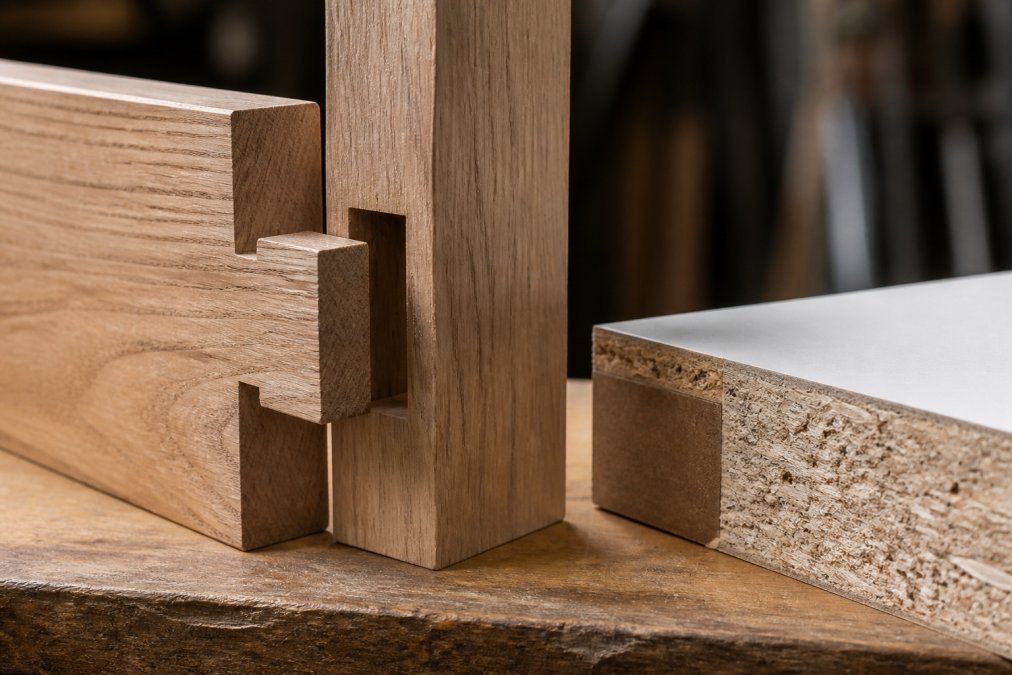
Mass-produced furniture uses industrialization to keep costs low. CNC machining creates perfectly uniform cuts, but the material itself, particle board held together with glue and mechanical fasteners, simply doesn't have the structural integrity of solid wood. It's engineered for a 5-7 year lifespan, not a 50-year one.
Custom builders like PIONEER WOODWERX source real wood, select grain patterns, and use joinery techniques that distribute stress across joints rather than concentrating it at fastener points. The difference in longevity is measurable: a well-made custom piece often outlasts three generations of mass-produced alternatives.
Benefits of Custom Cabinetry and Personalization
Custom furniture solves problems that mass-produced pieces simply can't address. Your kitchen has unusual ceiling height. Your bathroom has an awkward corner. Your bedroom needs built-in storage that fits your exact space. Mass-produced options force you to work around their standard dimensions.
With custom cabinetry and personalization, you're designing for your home, not adapting your home to fit what's available. This is where custom furniture becomes genuinely practical, not just aesthetically appealing. A custom kitchen island can be precisely 36 inches tall to match your counters, 48 inches wide to fit your layout, and include drawers exactly where you need them. A mass-produced island comes in preset sizes, you either accept the compromise or keep shopping.
The personalization extends beyond dimensions. You choose wood species, stain colors, hardware finishes, and interior configurations. You decide whether you want a natural matte finish or a high-gloss lacquer. You specify soft-close hinges or traditional hardware. Mass-produced furniture offers limited finish options, typically whatever the manufacturer decided would appeal to the broadest market.
For families in Central New Jersey planning full-scale kitchen or bathroom renovations, this flexibility is invaluable. Custom builds adapt to your specific plumbing, electrical, and structural constraints. They integrate with your existing design language instead of standing apart as obviously "store-bought."
Cost, Lead Times, and Timeline Expectations
This is where the conversation gets practical. Custom furniture requires upfront planning and patience. Mass-produced furniture is available immediately but costs compound over time through replacement cycles.
When you order custom pieces, you're paying for design consultation, material selection, skilled labor, and the time it takes to build properly. Lead times typically range from 8-16 weeks depending on complexity and the builder's schedule. You'll need to make decisions early, wood species, finishes, hardware, before construction begins.
Mass-produced furniture has no lead time. You can walk into a store, order online, and have it delivered within days or weeks. The upfront cost per item feels lower. But here's where the math shifts: when that particle board dresser fails in seven years and you replace it again in another seven years, you've bought the same piece three times while a custom piece is still standing.
For homeowners working with a general contractor on custom home projects, the timeline alignment matters. If you're renovating a kitchen or bathroom, coordinating custom cabinetry with construction phases prevents delays. PIONEER WOODWERX manages this scheduling so your custom builds arrive when the space is ready for installation, not weeks before or after.
The cost conversation also depends on scale. A single custom dining table represents a significant investment. Custom cabinetry for an entire kitchen renovation spreads that investment across multiple functional pieces, improving the overall value proposition. A single mass-produced nightstand feels cheap. Five pieces of custom bedroom furniture feels like a considered investment.
Durability, Longevity, and Resale Value
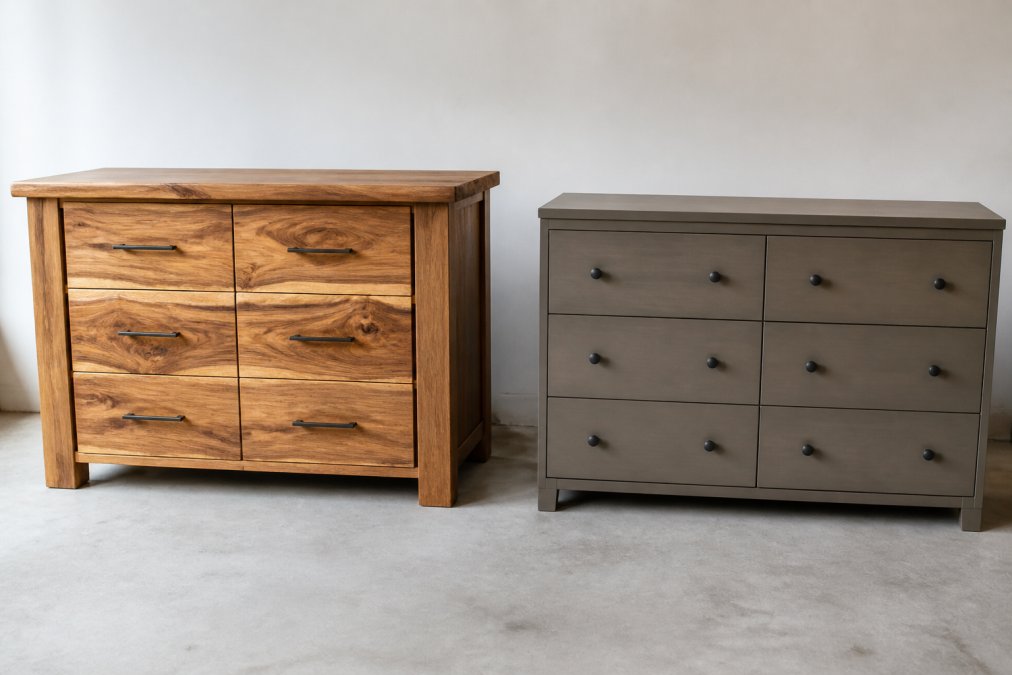
Custom furniture built from solid hardwood with traditional joinery holds value in ways mass-produced pieces don't. A 20-year-old custom dresser in good condition can be refinished and passed to the next generation. A 20-year-old particle board dresser is destined for the landfill.
Longevity translates directly to resale value. When you sell a home with custom built-in cabinetry, kitchen islands, or bathroom vanities, buyers see those as permanent improvements. Mass-produced furniture comes with you, it's not part of the home's value. Custom pieces become part of the property itself.
The durability advantage compounds with maintenance. Custom wood pieces can be sanded and restained indefinitely. Particle board can't be refinished; once the surface is damaged, the piece is compromised.
For families planning aging-in-place modifications in Central New Jersey, this matters. Custom-built safety features, grab bars integrated into cabinetry, or modified storage solutions designed for accessibility are built to last as long as the home itself.
Custom Home Renovation Trends and Design Flexibility
The trend in home renovation is moving toward personalization. Cookie-cutter homes with identical mass-produced furnishings are giving way to spaces designed around how families actually live. Custom furniture supports this shift because it adapts to your specific needs rather than forcing you to adapt to its limitations.
Hiring a General Contractor for Custom Home Projects
When you're deciding between custom furniture and mass-produced options as part of a larger renovation, working with a general contractor who understands both becomes essential. PIONEER WOODWERX manages the entire process, from initial consultation through final installation, ensuring custom pieces arrive on schedule and integrate seamlessly with the rest of your renovation.
Which Option Is Right for Your Home
The decision comes down to what matters most: immediate availability and lower upfront cost, or durability, customization, and long-term value.
Choose mass-produced furniture when:
- You need pieces immediately and timeline is critical
- You're furnishing a rental or temporary space
- You're buying single accent pieces, not entire rooms
- Your space has standard dimensions and your needs are straightforward
- Budget constraints make upfront cost the deciding factor
Choose custom furniture when:
- You're planning a major renovation (kitchen, bathroom, basement, whole home)
- Your space has non-standard dimensions or challenging layouts
- You want pieces to last 20+ years and potentially pass to the next generation
- You're seeking integrated design across multiple rooms
- You're implementing aging-in-place modifications that require specialized design
- Long-term value and durability matter more than immediate availability
The comparison table below summarizes the key trade-offs:
| Factor | Custom Furniture | Mass Produced |
|---|---|---|
| Material Quality | Solid hardwood, traditional joinery | Particle board, MDF, veneers |
| Lead Time | 8-16 weeks typical | Days to 2 weeks |
| Design Flexibility | Fully customizable to your space | Limited to standard sizes |
| Durability | 30+ years with maintenance | 5-10 years typical |
| Personalization | Wood species, finishes, hardware | Limited preset options |
| Resale Value | Adds value to home | Depreciates immediately |
| Maintenance | Can be refinished | Limited long-term maintenance |
| Initial Cost | Higher | Lower |
| Cost Per Year | Lower (amortized over decades) | Higher (frequent replacement) |
Frequently Asked Questions
Is custom furniture really more durable than mass-produced alternatives?
Yes. Custom furniture built with solid hardwood and traditional joinery techniques typically lasts 20-30+ years, while mass-produced pieces using particle board or MDF often show wear within 5-10 years. Solid wood resists warping and handles repeated use better. The structural integrity of hand-fitted joints outperforms stapled or glued assembly. When properly maintained, custom pieces become heirlooms; mass-produced items are often discarded when they fail.
What are the main benefits of custom cabinetry for a kitchen renovation?
Custom cabinetry maximizes your space, fits non-standard layouts, and matches your exact style preferences. You control wood species, finishes, hardware, and interior organization. Custom pieces integrate seamlessly with aging-in-place modifications like lower shelving for accessibility. You also avoid the generic look of flat-pack cabinets. The investment pays back through improved functionality and home resale value, especially in competitive markets.
How long does custom furniture actually take compared to buying mass-produced?
Mass-produced furniture ships in days or weeks. Custom pieces typically require 8-16 weeks from design approval to delivery, depending on complexity and material sourcing. Lead times account for design consultation, material selection, CNC machining or hand-finishing, and quality inspection. While longer upfront, this timeline ensures precision fitting and craftsmanship. Delays are rare when working with established builders who manage timelines professionally.
Should I hire a general contractor for custom home projects, or work with a furniture maker directly?
A general contractor experienced in custom home projects manages the entire scope: design integration, installation, and coordination with other trades (plumbing, electrical, flooring). This ensures custom pieces fit perfectly within your kitchen, bathroom, or basement renovation. Direct furniture makers excel at craftsmanship but may not coordinate installation or handle structural modifications. For full-home renovations, a contractor streamlines the process and guarantees accountability.