 how-to
How to Tell If Antique Furniture Is Real Wood
Last Updated: October 24, 2026
Quick Summary
To tell if antique furniture is real wood, check grain continuity across edges and corners, inspect unfinished drawer interiors and undersides, and look for visible end grain. Solid wood shows grain flowing around corners with no seam, while veneer stops at a thin edge line.
- Work through all six checks in the same order, since no single test proves anything alone.
- Grain continuity is the most reliable visual test, but confirm it on the underside.
- Most antiques are mixed construction, so judge each component separately rather than the whole piece.
- Rank evidence in tiers: construction and hidden surfaces outrank weight, color, and sound.
- Never sand, scrape, or pry a valuable antique; use a low-angle flashlight instead.
Table of Contents
- Start With a Systematic Inspection Sequence
- How to Tell If Furniture Is Solid Wood or Veneer
- How to Identify Wood Veneer on Antique Furniture
- How to Check If a Table Is Real Wood
- Weigh the Clues: Species, Color, Patina, and Joinery
- Safe, Non-Destructive Checks for Valuable Antiques
- When to Call an Appraiser or Furniture Conservator
- Request a Free Consultation Before You Buy or Build
- Frequently Asked Questions
Start With a Systematic Inspection Sequence
Learning how to tell if antique furniture is real wood starts with one habit: look before you touch, and touch before you trust. At PIONEER WOODWERX, we build with 100% real wood, so we know exactly where imitation shows itself.
Here is the sequence we use:
- Step back and look at the whole piece. Check grain flow across every surface.
- Open a drawer and feel the inside. Unfinished wood tells the truth.
- Flip the piece over. Look at the underside and back panel.
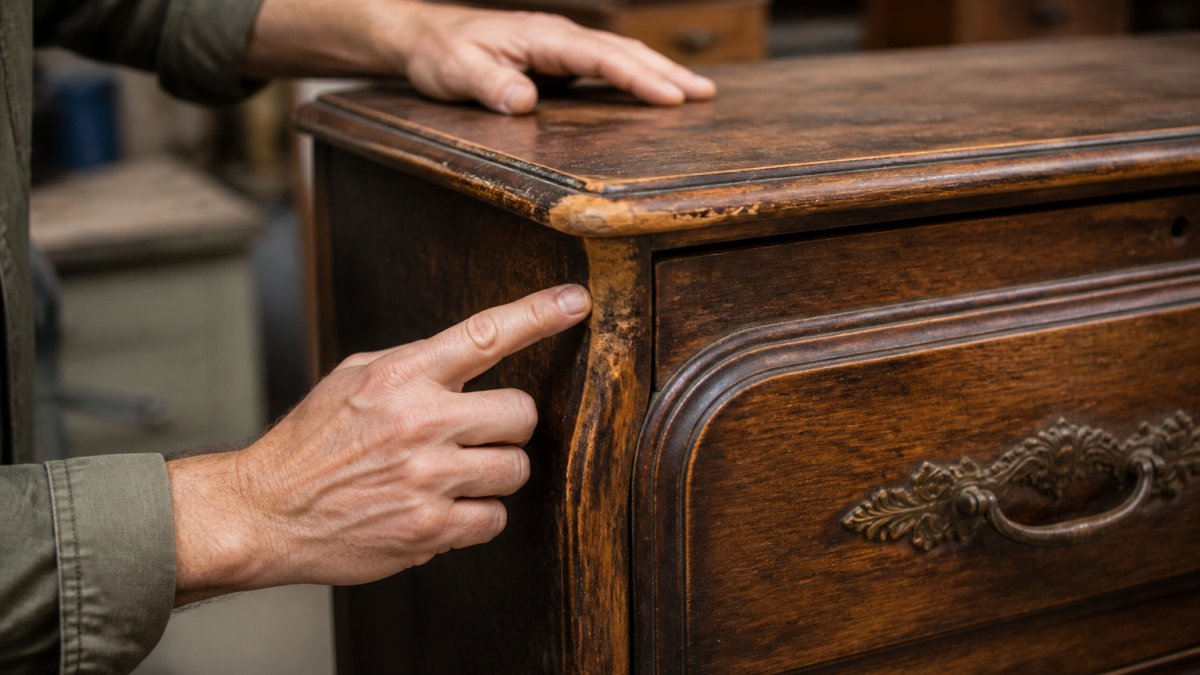
- Check the edges and corners. Veneer shows a seam; solid wood does not.
- Test the weight with a lift. Heavy is a clue, not proof.
- Inspect the joinery. Dovetails and mortise-and-tenon joints point to age and quality.
Work through all six. No single check proves anything on its own. For a deeper walkthrough of the same checks, read our step-by-step guide to identifying solid wood furniture.
What Each Check Can and Cannot Prove
Grain continuity can prove a surface is veneered. It cannot prove the core is solid. Weight can suggest density. It cannot rule out a heavy manufactured board. Joinery can point to a period. It cannot confirm a species.
Treat each test as one vote, not a verdict.
How to Tell If Furniture Is Solid Wood or Veneer
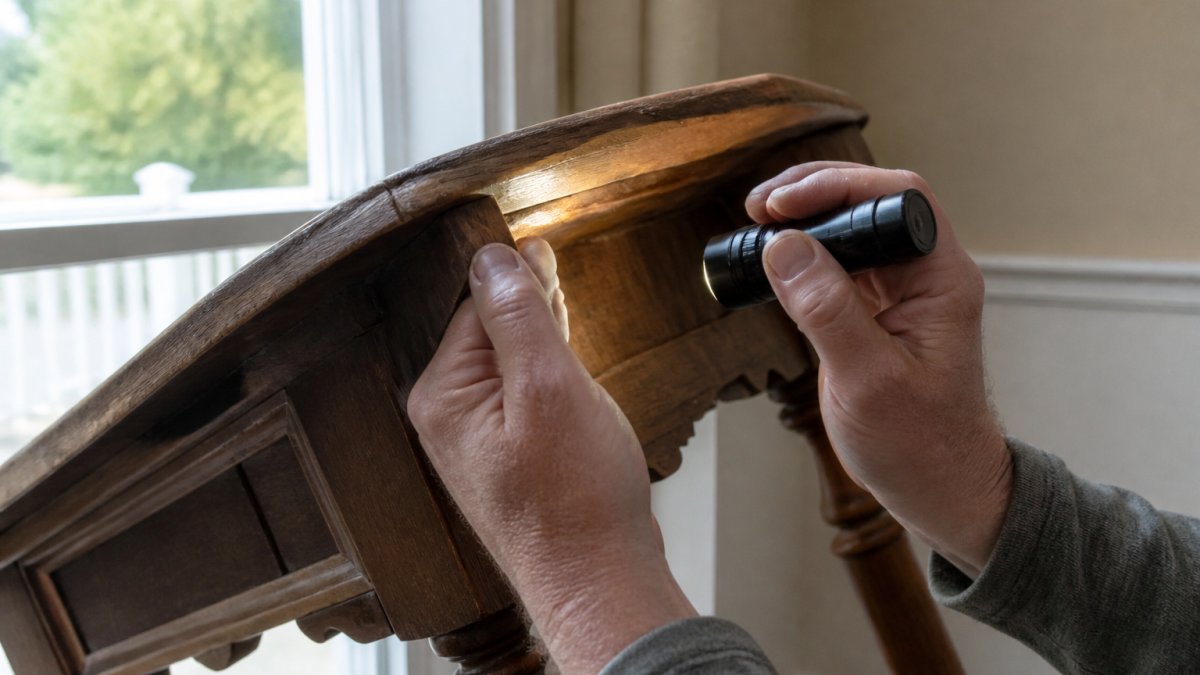
The fastest way to tell if furniture is solid wood or veneer is to follow one grain line across an edge. On real wood, the grain runs continuously from the top face around the corner and down the side.
A few more signals separate the two:
- End grain: Solid boards show visible end grain on edges. Veneer shows a thin line of backing material.
- Repetition: Identical grain patterns on two drawers mean a printed or sliced veneer.
- Sound: A light tap on solid wood sounds dull and even. A hollow ring hints at a core underneath.
Reading Grain Continuity Across Surfaces
Grain continuity is the single most reliable visual test. Real wood keeps its pattern flowing around corners, legs, and rails. Fake wood repeats it, mirrors it, or stops it dead at a seam.
Watch out: a skilled maker can book-match veneer so well that the pattern looks continuous. Always confirm with the underside before you decide.
How to Identify Wood Veneer on Antique Furniture
To identify wood veneer on antique furniture, look for a paper-thin top layer sitting over a different material. Genuine antique veneer is real wood sliced thin, so the grain looks natural. Modern imitation uses printed laminate or vinyl, and the pattern gives it away.
Check these spots:
- Edges: A fine seam or a slightly raised lip where the top layer meets the side.
- Corners: Chipped corners often expose a lighter core board underneath.
- Back panel: Thin, uniform sheets with no end grain are a strong sign of veneer.
Most Antiques Are Mixed Construction, Not All-or-Nothing
This is where most online guides mislead buyers. On antique case goods, it is common for the frame, legs, and rails to be solid wood while the flat panels, tabletops, drawer fronts, door faces, and side panels, are veneered.
That means the question is rarely "is this piece solid or fake?" It is "which components are solid, and which are veneered?" Work component by component:
| Component | Usually Solid on Antiques | Usually Veneered on Antiques |
|---|---|---|
| Legs and posts | Yes, turned or carved from one block | Rarely |
| Rails and stretchers | Yes | Rarely |
| Tabletop | Sometimes (plank tops) | Often (fine case goods) |
| Drawer fronts | Sometimes | Often, especially curved fronts |
| Door and side panels | Sometimes | Often, to control movement |
| Back panel | Sometimes | Often thin secondary wood |
A veneered panel is not a defect or a fake. It is a deliberate technique that lets a maker use highly figured wood on a stable core, and it has been standard in fine furniture since the 1600s.
Veneer Patterns, Edges, and Underside Clues
Book-matched veneer creates a mirror image down the center of a tabletop. That is a hallmark of fine antique case goods, not a fake. The underside settles it. Flip the piece and compare the bottom to the top.
If the bottom is a plain, uniform sheet and the top is a dramatic pattern, you are looking at veneer over a secondary wood.
Reading the Core Through Wear and Damage
Where a finish has worn through or a corner has chipped, look at what sits under the surface layer. A solid board keeps showing the same wood all the way down. A veneered panel reveals a straight, glue-line seam and a different species underneath, often a lighter, plainer wood.
Use a low-angle flashlight along an edge rather than a blade. The shadow line reveals a seam without risking the finish.
How to Check If a Table Is Real Wood
To check if a table is real wood, start underneath. Run your hand along the underside of the top and look for end grain at the edges. A solid top shows boards joined edge to edge, often with a visible seam line. A veneered top shows a smooth, uniform sheet.
Then work through this quick table:
| Check | Solid Wood Sign | Veneer or Fake Sign |
|---|---|---|
| Tabletop edge | Visible end grain | Thin seam, raised lip |
| Underside | Board seams, natural grain | Uniform sheet, no grain |
| Weight | Heavy for its size | Light or oddly balanced |
| Grain across top | Flows with the boards | Mirrored or repeating |
| Corner wear | Wears into more wood | Chips to a lighter core |
One test rarely settles it. Three agreeing tests usually do.
Weigh the Clues: Species, Color, Patina, and Joinery
Species, color, and patina are supporting evidence, not proof. Our wood and stain color options give you a visual reference of species and finishes to compare against the piece.
U.S. Forest Service wood identification guide explains how trained examiners read grain and cell structure to name a species.
Patina is the wear pattern that builds with age. Real antiques show it in the right places: armrests, drawer pulls, and feet. Uniform color everywhere is a warning sign.
Rank the Evidence Instead of Counting It
Most guides tell you to gather clues. The useful skill is knowing which clues outrank which. Treat the evidence in tiers:
- Strong, construction and hidden surfaces. End grain on an edge, board seams on an underside, and joinery visible from below or behind are hard to fake convincingly. These outrank everything else.
- Medium, grain behavior. Grain that flows around a corner and continues on the adjacent face is meaningful. Grain that stops at a seam or repeats identically on two drawers is a strong veneer or laminate signal.
- Weak, weight, color, and sound. These are the clues buyers over-trust. Solid oak is heavy, but so is dense particle board. A dull tap suggests solid wood, but a thick veneered panel over a solid core can sound dull too.
When a strong clue conflicts with a weak one, trust the strong one. When two strong clues agree, you have a working conclusion. When they disagree, that is your signal to stop guessing and get a second opinion.
Weight, Wear, and Dovetail Joints
Weight helps, with a caveat. Solid oak is heavy. So is dense particle board. Lift the piece and compare it to similar furniture you own.
Dovetail joints are a stronger clue. Hand-cut dovetails, slightly uneven and spaced by eye, point to older construction.
Smithsonian Institution furniture care guidance notes that construction details like joinery are among the best indicators of a piece's period and method of make.
Read Construction Changes Across Periods
Applying modern expectations to an antique causes misreads. Construction changed over time, and those changes are themselves evidence:
- Hand-cut dovetails with wide, irregular spacing point to earlier work; machine-cut dovetails with uniform spacing point to later production.
- Cut nails versus wire nails in a drawer bottom or back panel help bracket a piece's era; wire nails became common in the late 1800s.
- Sawn veneer versus sliced veneer, earlier veneer was often thicker and sawn; later veneer is thinner and more uniform.
When the Clues Do Not Agree
If your strong clues conflict, say, continuous grain on one edge but a visible seam on the opposite edge, you may be looking at a piece with mixed construction, which is common and not automatically a problem. Photograph each conflicting area, note which component it belongs to, and treat the piece as mixed until an appraiser or conservator resolves it.
Safe, Non-Destructive Checks for Valuable Antiques
Never sand, scrape, or pry a piece you think is valuable. Every safe check works on the surface.
- Look, do not probe. Use a flashlight at a low angle to read grain.
- Open every drawer and door. Inspect interiors only.
- Lift carefully and check the weight.
Watch out: a water drop test can stain a finish and lower a piece's value. Leave moisture tests to a professional.
When to Call an Appraiser or Furniture Conservator
Call an appraiser when the piece may be worth more than you paid, when a maker's mark is present, or when you need a value for insurance or an estate.
American Society of Appraisers lists credentialed appraisers who follow published standards. To compare real solid-wood construction firsthand, browse our handcrafted hardwood tables.
If you are shopping in Old Bridge or nearby and want to see solid-wood construction up close, our custom woodwork shows what honest joinery looks like.
Request a Free Consultation Before You Buy or Build
The hardest part of buying antique furniture near me is trusting what you see. Grain can be matched. Weight can be faked. A second set of trained eyes settles it fast.
That is where we come in. If you are weighing a purchase or planning a custom piece, request a free consultation and talk it through with a woodworker first.
Frequently Asked Questions
Does a visible wood grain pattern prove that furniture is solid wood?
No. A printed or photographed grain pattern on laminate can mimic real wood convincingly, and veneer shows genuine grain because it is a thin slice of real wood. Check grain continuity across edges and corners: on solid wood the grain wraps around and repeats on the end grain, while veneer often stops at the edge or shows a seam. Look at the underside and back panel too, since manufacturers sometimes use a different material there.
How can you tell if an antique table is real wood?
Inspect the tabletop edge and underside first. Solid wood shows grain running through the thickness and matching end grain at the corners; veneer shows a thin top layer over a different core, sometimes with a visible seam or bubbling. Lift one side to gauge weight, check the apron and legs for consistent species and color, and examine drawer joints for dovetails. If the piece is valuable, have an appraiser confirm before you buy.
How do you identify wood veneer on antique furniture?
Look for repeating grain patterns across adjacent surfaces, a thin edge line where the top layer meets the core, and small bubbles or lifting near corners and edges. Shine a light at a low angle to catch seams. On antique pieces, veneer was often hand-cut and applied over solid wood, so a veneered surface does not automatically mean low quality. Check the underside and back panel for the same species and grain flow.
When should you seek an appraiser or furniture conservator?
Call a professional when the piece may be valuable, when you see signs of age such as hand-cut dovetails or old patina, or when you cannot inspect safely without risking damage. An appraiser can confirm species, construction, and period, and a conservator can advise on care. For pieces you plan to keep or insure, a written appraisal is worth the cost. For everyday buying, a careful inspection sequence handles most decisions.
Judging real wood takes patience, a flashlight, and a fixed sequence you repeat every time. When a piece matters, get an expert opinion before you commit. Get started with PIONEER WOODWERX and build or buy with confidence in what the wood actually is.