 comparison
Solid Wood vs Particle Board Furniture: A Buyer's Guide
Table of Contents
- Solid Wood vs Particle Board: Quick Comparison
- How to Identify Solid Wood Furniture
- Durability and Structural Integrity
- Cost-Effectiveness and Long-Term Value
- Benefits of Custom Wood Furniture
- Repair, Maintenance, and Refinishing
- Environmental Impact and Sustainability
- Frequently Asked Questions
Last Updated: September 3, 2026
Solid Wood vs Particle Board: Quick Comparison
When you're furnishing a home in Old Bridge or anywhere in Central New Jersey, the choice between solid wood and particle board furniture shapes everything: how long your pieces last, how they weather moisture and humidity, what they'll cost over a decade, and whether you're building heirloom pieces or planning for replacement cycles. This guide breaks down solid wood vs particle board furniture so you can make an informed decision aligned with your budget, climate, and values.
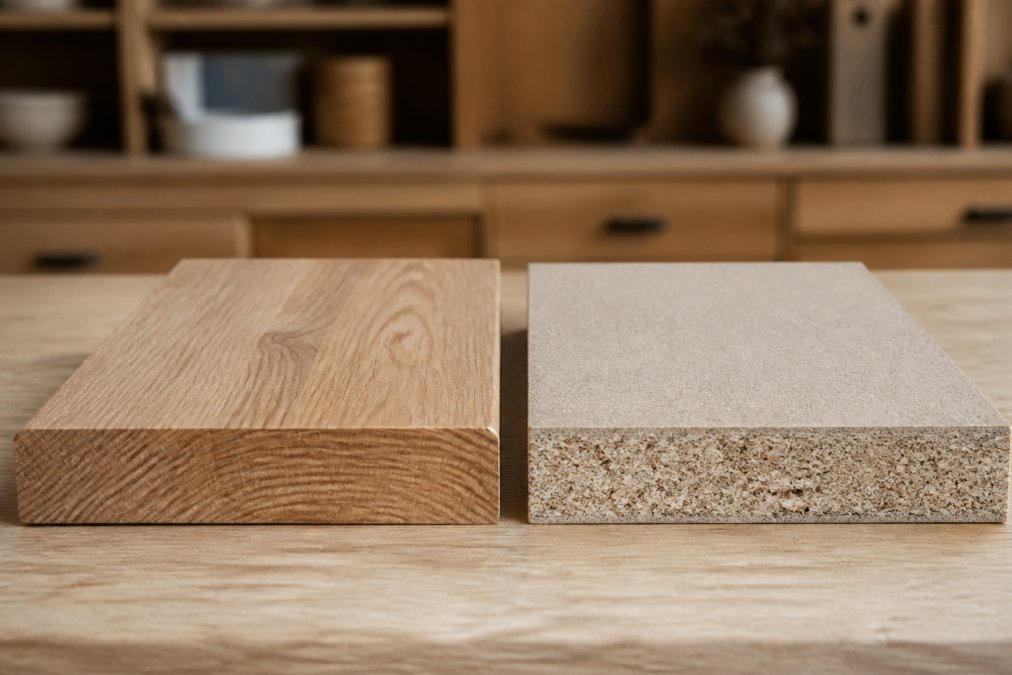
Solid wood furniture is built from planks of actual timber, oak, cherry, maple, walnut, joined with traditional joinery like mortise-and-tenon joints, dowels, or dovetails. Particle board, by contrast, is engineered wood made from wood chips, sawdust, and adhesive compressed into dense sheets. The difference isn't cosmetic. Solid wood develops character over time, can be refinished repeatedly, and often outlasts the homeowners who buy it. Particle board is affordable, consistent, and stable in controlled environments, but it has hard limits on durability and repairability.
At PIONEER WOODWERX, we work exclusively with solid wood for custom furniture and built-ins because our clients in Central New Jersey are investing in pieces they want to pass down. But particle board has legitimate uses, and understanding where each material excels helps you spend wisely.
Below, we'll compare durability, moisture resistance, cost, repairability, and environmental impact so you can choose the right material for your space.
| Characteristic | Solid Wood | Particle Board |
|---|---|---|
| Durability | 20-50+ years with care | 5-15 years typical |
| Moisture Resistance | Poor without finish; good with sealing | Poor; swells and delaminates easily |
| Weight | Heavy; requires proper support | Light; easy to move |
| Cost (initial) | Higher | Lower |
| Repairability | Excellent; can be sanded, stained, refinished | Limited; damage often permanent |
| Structural Integrity | Excellent; high screw holding power | Fair; screws loosen over time |
| Aesthetics | Grain, character, natural variation | Uniform; veneer can mimic wood |
| Environmental Impact | Variable; depends on sourcing | Lower initial cost; higher waste |
How to Identify Solid Wood Furniture
The easiest way to avoid overpaying for particle board disguised as solid wood is to know what to look for. Real solid wood has distinctive markers that particle board can't replicate convincingly.
Start by examining the edges and undersides. Solid wood shows grain running through the thickness, if you see the edge of a board, the grain pattern continues all the way through. Particle board edges are uniform, smooth, often covered with veneer or edge banding to hide the compressed chips underneath. Run your hand along the underside of a table or the back of a cabinet. Solid wood feels organic, with grain variation and occasional imperfections. Particle board feels flat, featureless, sometimes slightly rough from the compressed surface.
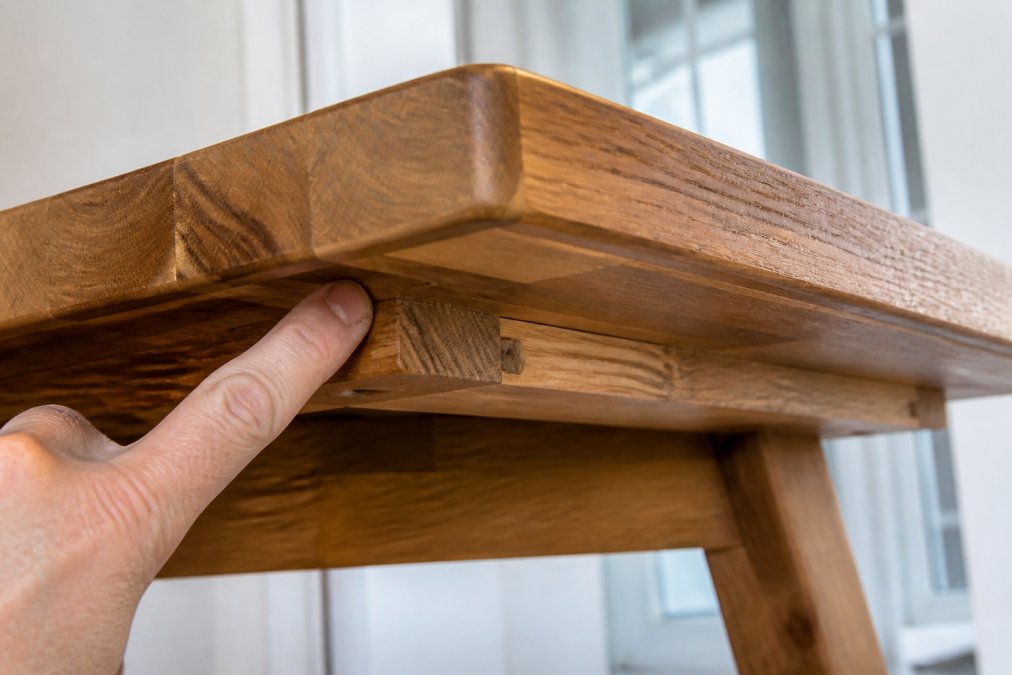
Weight is another reliable test. Solid wood is dense and heavy, a solid wood dining table for four people weighs 80-120 pounds. Particle board is lighter because it's mostly air pockets held together by adhesive. If a "wood" piece feels suspiciously light for its size, it's likely engineered.
Look at joinery. Solid wood furniture uses visible joinery: mortise-and-tenon joints where one piece fits into a hole in another, dovetail joints with interlocking fingers, or dowel joints. These require real wood because they rely on the wood's structural integrity. Particle board can't support traditional joinery, instead, it uses cam locks, metal brackets, or screws driven into the surface. If you see only screws and metal hardware holding pieces together, that's engineered wood.
Check the grain pattern. Real wood grain is irregular, unique, and continuous across a surface. Veneer over particle board attempts to mimic this, but the grain is often repetitive, you'll see the same pattern repeated, which doesn't happen in nature. Lift a corner of veneer if possible; particle board shows underneath.
Finally, examine how the wood responds to pressure. Press your fingernail gently into an inconspicuous area. Solid wood will leave a small indentation that doesn't spring back immediately, the wood is compressed but remains structurally sound. Particle board may indent or, worse, crumble slightly because the adhesive bond is weaker.
Durability and Structural Integrity
Solid wood furniture lasts decades when cared for properly. The material's cellular structure allows it to flex slightly under stress without breaking, and the wood's natural strength means joints remain tight. A well-made solid wood chair built in 1980 can still be sat in today with no structural compromise. Particle board furniture typically lasts 5-15 years before joints weaken, surfaces chip, and structural failure becomes likely.
Load-Bearing Capacity and Longevity
Solid wood has superior load-bearing capacity because the material's density and grain structure create high tensile strength and compressive strength. A solid wood shelf can safely hold 50-100 pounds per foot of span depending on thickness and wood species. Particle board shelving of the same dimensions might safely hold 20-30 pounds before sagging or failing (astm.org).
The difference compounds over time. Solid wood actually improves in some ways, it becomes more stable as it acclimates to its environment and develops a patina. Particle board degrades. Screws loosen as the material around them compresses. Joints fail because the adhesive bond weakens. Veneers peel. After 10-15 years of regular use, particle board furniture often requires replacement rather than repair.
This matters in Old Bridge's climate, where humidity fluctuates seasonally. Solid wood, properly finished, handles these swings. Particle board doesn't, the engineered material swells and shrinks unevenly, creating stress at joints.
Moisture Resistance and Warping
Moisture is particle board's enemy. The adhesive holding the compressed chips together breaks down when exposed to humidity or water. Even moderate moisture causes swelling, delamination (where layers separate), and permanent damage. A particle board shelf exposed to bathroom humidity will swell noticeably within months.
Solid wood also absorbs moisture, but it does so slowly and uniformly. Properly sealed solid wood, finished with polyurethane, lacquer, or oil, resists moisture effectively. Even unfinished solid wood is more forgiving than particle board. If solid wood gets wet, it swells temporarily but returns to its original dimensions as it dries. Particle board doesn't recover; the swelling is often permanent.
Warping is common in solid wood if it's not properly acclimated and finished, but it's a solvable problem. A warped solid wood tabletop can be carefully sanded flat and refinished. Warped particle board is scrap.
Cost-Effectiveness and Long-Term Value
The initial cost difference is stark. A particle board dresser might cost $200-400 new. A comparable solid wood dresser costs $800-1,500. Over a 20-year horizon, though, the math changes.
If you buy particle board, you're replacing it every decade. Two replacements over 20 years means $400-800 total spent, plus the hassle and environmental cost of disposal. If you buy solid wood at $1,000, you spend that once. The piece is still functional, still beautiful, and still worth something on the secondhand market. Many solid wood pieces appreciate slightly because they're increasingly rare.
For custom work, built-in cabinetry, kitchen islands, dining tables, the value proposition strongly favors solid wood. Custom particle board is almost never made because the material doesn't justify the labor. Custom solid wood from craftspeople like PIONEER WOODWERX costs more upfront but creates pieces that define a home for generations.
The real cost-effectiveness question isn't "which is cheaper today" but "what am I building for?" If you're furnishing a rental or a temporary space, particle board makes sense. If you're investing in your home in Central New Jersey for the long term, solid wood delivers better value.
Benefits of Custom Wood Furniture
Custom solid wood furniture solves problems that off-the-shelf pieces can't. When you commission a custom piece, you're getting wood selected for your specific space, joinery built to last, and finishes that match your home's aesthetic and climate needs.
Custom pieces are built to your exact dimensions. A custom dining table fits your room perfectly. A custom bedroom set matches your ceiling height and wall layout. Off-the-shelf furniture forces you to adapt your space to the piece; custom work does the opposite.
The wood species can be chosen for your needs. Want a table that's durable enough for a family with young children? Cherry or maple. Prefer something with dramatic grain? Walnut or ash. Need a light, Scandinavian aesthetic? White oak or ash. A custom craftsperson helps you select wood that matches your climate, your style, and your budget.
Joinery in custom work is superior because craftspeople take time to fit joints precisely. Mortise-and-tenon joints, dovetails, and traditional methods create strength that lasts. Factory-made solid wood furniture often uses simpler joinery to save labor; custom work doesn't cut corners.
Finishing is tailored to your environment. In Old Bridge's humid climate, a custom craftsperson will seal wood appropriately to resist moisture. The finish can be adjusted for your lifestyle, matte for a natural look, satin for durability, or high-gloss for elegance.
Repairability is built in. If a custom piece sustains damage, the maker can repair it properly. A scratched custom table gets sanded and refinished. A loose joint gets re-glued and re-fitted. The piece improves rather than degrades.
Repair, Maintenance, and Refinishing
Solid wood's greatest advantage is repairability. Scratches, dents, stains, and even structural damage can often be fixed.
Minor scratches disappear with sanding and refinishing. A solid wood tabletop that's seen 15 years of use can be sanded smooth, stained to match the original finish, and sealed again. The cost is a few hundred dollars and a week or two of work. The table looks new again.
Loose joints can be re-glued. If a chair's mortise-and-tenon joint loosens, a craftsperson can disassemble it, clean out old glue, apply fresh adhesive, and reassemble it. The joint is as strong as it was originally.
Water damage is manageable. If solid wood gets wet, the wood can be dried carefully, sanded if necessary, and refinished. The piece survives.
Particle board, by contrast, offers almost no repair options. A dented particle board surface can't be sanded smooth without exposing the interior. Swollen particle board from water damage is permanent, the material doesn't recover. Loose screws in particle board can't be tightened because the material around them is already compressed. Once particle board fails, replacement is the only option.
Maintenance for solid wood is straightforward. Dust regularly with a soft cloth. Use wood-appropriate cleaners, avoid harsh chemicals that strip finishes. Refinish every 5-10 years depending on use. Keep humidity moderate (30-50%) to minimize movement (si.edu).
Particle board requires minimal maintenance because there's nothing to maintain, once it fails, you discard it.
Environmental Impact and Sustainability
The environmental calculus favors solid wood over the long term, though the picture is nuanced.
Particle board uses waste wood, sawdust and chips from lumber mills, that might otherwise be burned or landfilled. In that sense, it's recycling. However, particle board requires adhesives, often containing formaldehyde or other volatile organic compounds (VOCs), to bind the compressed material. These chemicals off-gas, particularly in new furniture, contributing to indoor air quality issues. Solid wood requires only finish, stain, polyurethane, or oil, which also contains VOCs but in smaller quantities.
The lifecycle environmental cost favors solid wood. A particle board piece used for 10 years and discarded has a relatively low per-year environmental footprint, but multiply that by the fact that you'll replace it twice in 20 years, and the total environmental impact compounds. Solid wood used for 30 years has a lower per-year impact because the initial manufacturing cost is amortized over a longer life.
Sourcing matters for both. Sustainably harvested solid wood, certified by the Forest Stewardship Council (FSC) or similar bodies, ensures forests are managed responsibly. Particle board can be made from sustainably sourced waste, or it can be made from virgin timber ground up unnecessarily. Ask your supplier about sourcing.
Disposal is another factor. Solid wood is biodegradable and can be composted or burned for energy recovery at end of life. Particle board with adhesives and veneers is harder to recycle and often ends up in landfills.
For homeowners in Central New Jersey prioritizing environmental responsibility, solid wood from responsibly managed sources is the better choice, particularly when the piece is expected to last decades and be refinished rather than replaced.
Choosing between solid wood and particle board furniture comes down to your timeline, budget, and values. If you're furnishing temporarily or on a tight budget, particle board serves a purpose. If you're investing in your home, solid wood delivers better long-term value, repairability, and durability.
PIONEER WOODWERX specializes in custom solid wood furniture and built-ins designed to last generations. Our craftspeople select materials carefully, build with traditional joinery, and finish pieces to withstand Central New Jersey's climate. Whether you're planning a kitchen renovation, custom dining furniture, or built-in cabinetry, solid wood from a local craftsperson creates spaces that improve how your family lives. Request a free consultation to discuss your project and see how custom wood furniture can transform your home.
Frequently Asked Questions
How can you tell the difference between solid wood and particle board?
Examine the edges and underside of the furniture. Solid wood shows consistent grain patterns and natural wood color throughout; particle board appears as compressed particles held together with adhesive. Check the weight, solid wood is heavier. Look at joinery: solid wood uses mortise-and-tenon or dovetail joints; particle board relies on cam locks and dowels. Press the surface; solid wood feels firm and solid wood resists indentation, while particle board dents easily. Finally, inspect where shelves or legs attach; solid wood allows for screw holding power, whereas particle board screws may strip or pull loose over time.
What are the primary downsides of particle board furniture?
Particle board lacks durability and structural integrity compared to solid wood. It swells and warps when exposed to moisture, making it unsuitable for kitchens or bathrooms without protective laminate or veneer. Screw holding power is poor, fasteners loosen with use and cannot be re-tightened reliably. Particle board cannot be refinished or repaired like solid wood; once damaged, the piece is often discarded. It also contains formaldehyde and VOC emissions from adhesives, affecting indoor air quality. The material delaminate under stress, and its tensile strength and compressive strength are significantly lower than hardwood or softwood.
Does solid wood furniture hold its value better than particle board?
Yes. Solid wood furniture appreciates or maintains value because it lasts decades with proper care and can be refinished or repaired. Heirloom-quality pieces made from hardwood like oak, walnut, or cherry become more valuable over time. Particle board furniture depreciates rapidly and has minimal resale value because it cannot be restored and deteriorates within 5-10 years. When calculating lifecycle cost, solid wood is more cost-effective despite higher upfront expense. Custom wood furniture designed to your specifications adds personalized value that mass-produced particle board cannot match.
What is a stronger, more durable alternative to particle board?
Solid wood, both hardwood and softwood, is significantly stronger. Hardwoods like oak, maple, and walnut offer superior density, tensile strength, and compressive strength. Softwoods like pine and cedar are still more durable than particle board and cost less than hardwoods. Engineered wood with a solid wood veneer over plywood provides better durability than particle board while offering some cost savings. For maximum longevity and strength, choose solid hardwood furniture, especially for pieces that bear weight or receive heavy use. Custom wood furniture built with traditional joinery and quality hardware outlasts particle board by 20+ years.
This article was written using GrandRanker