 comparison
Solid Wood vs Plywood for Custom Built-In Cabinets
Table of Contents
- Solid Wood vs Plywood for Custom Built-In Cabinets: A Quick Comparison
- Why Cabinet Boxes Are Where Material Choice Really Matters
- The Best Plywood for Custom Cabinets: What to Look For
- Cabinet Box Construction Standards That Separate Quality Builds
- How New Jersey Humidity Affects Cabinet Material Choice
- Custom Built-In Cabinet Design Ideas That Work With Either Material
- Making the Final Call on Your Custom Built-In Cabinets
- Frequently Asked Questions
Last Updated: September 22, 2026
Solid Wood vs Plywood for Custom Built-In Cabinets: A Quick Comparison
The solid wood vs plywood decision for custom built-in cabinets comes down to one principle: solid wood belongs on the parts you see, and plywood belongs in the parts that hold everything together. At PIONEER WOODWERX, we build kitchen, bathroom, and basement cabinetry, and that split is the single biggest factor in whether a cabinet box stays square for decades or racks out of alignment within a few seasons.
Here is the short version before the details:
| Component | Best Material | Why |
|---|---|---|
| Cabinet box (carcass) | Furniture-grade plywood | Dimensional stability, screw-holding strength |
| Doors and drawer fronts | Solid hardwood | Grain, finish depth, refinishing over time |
| Face frame | Solid hardwood | Rigidity and a clean visible edge |
| Painted flat panels | MDF | Smooth, consistent paint surface |
Why Cabinet Boxes Are Where Material Choice Really Matters
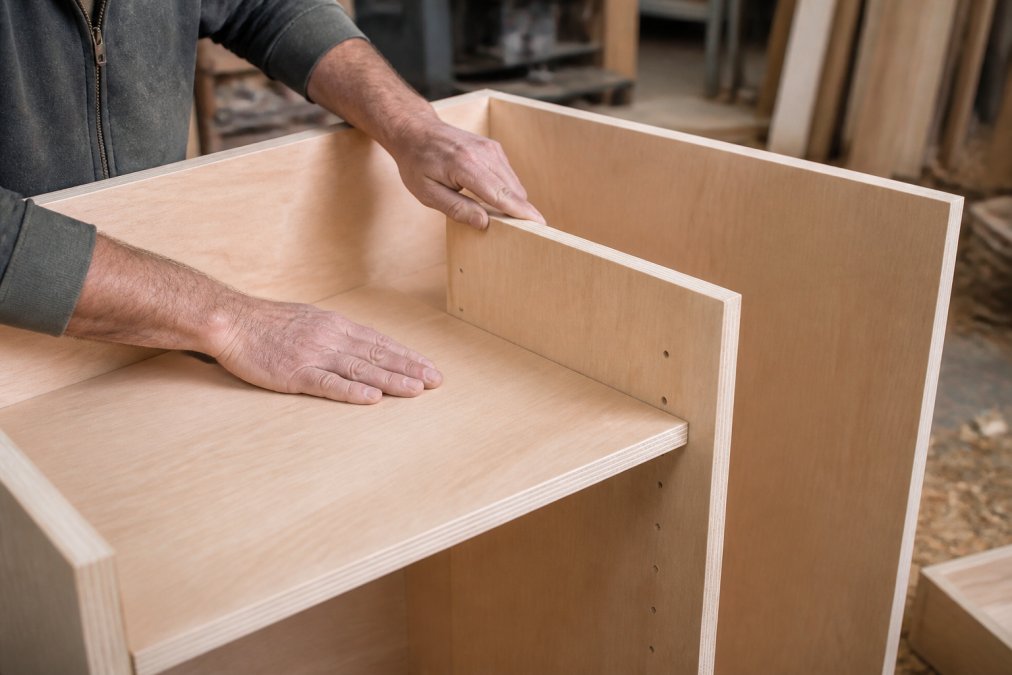
The cabinet box, or carcass, carries every load in your kitchen: dishes, small appliances, the weight of the countertop above, and the pull of every door and drawer. A box that swells, warps, or loses its fasteners takes the doors and drawers with it, no matter how nice those fronts look.
Face Frames vs. Cabinet Boxes: Two Different Jobs
A face frame is the solid wood framework on the front of the cabinet that the doors close against. It is visible, it takes dings, and it benefits from solid hardwood because the material can be sanded and refinished over the life of the kitchen. The cabinet box behind it is structural and mostly hidden. Different job, different material.
Why Solid Wood Is Not Ideal for Cabinet Carcasses
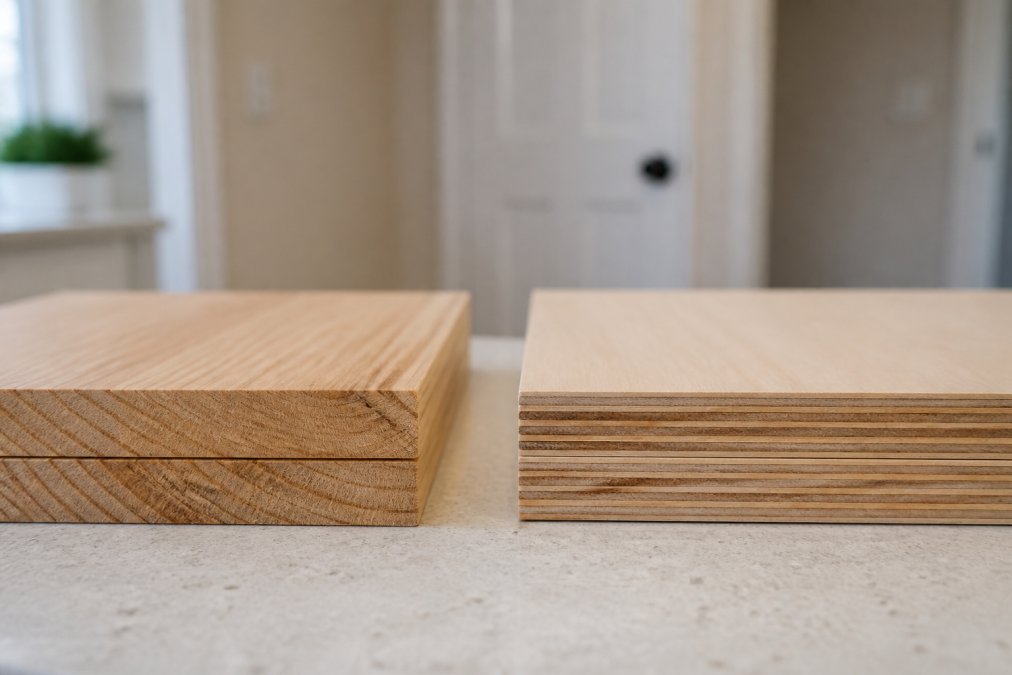
Solid wood moves. It expands and contracts with humidity changes, and a wide solid wood panel can swell enough to bind drawers or split at a joint. Plywood is built from cross-banded veneer layers, so it resists that movement in every direction. That is the whole argument in two sentences.
The Best Plywood for Custom Cabinets: What to Look For
The best plywood for custom cabinets is furniture-grade plywood with a hardwood veneer core, typically Baltic birch or a comparable multi-ply sheet. It holds screws, resists moisture, and stays flat. Cabinet-grade material is graded for void-free cores, because hidden gaps inside a sheet are where fasteners fail.
Furniture-Grade Plywood and Hardwood Veneer Options
Furniture-grade plywood is a sheet good built from thin layers of wood glued in alternating directions, then faced with a hardwood veneer such as maple, birch, oak, or cherry. The alternating layers deliver dimensional stability that a solid panel cannot match.
- Birch plywood: dense, multi-ply, excellent screw-holding for drawer boxes
- Maple plywood: tight grain, good for interiors that will be seen
- Hardwood veneer panels: match the door species so interiors look intentional
Cabinet Box Construction Standards That Separate Quality Builds
Cabinet box construction standards come down to four things: core quality, joinery, edge treatment, and hardware mounting. A box built to a high standard uses void-free plywood, glued and mechanically fastened joints, edge banding on every exposed ply edge, and hardware mounted into material thick enough to hold it. Here is what each of those means in practice, and how the material choice drives all four.
Core Quality and Sheet Thickness
Cabinet-grade plywood for boxes is typically 3/4 inch nominal thickness, built from an odd number of veneer plies so the faces balance each other. A 3/4-inch seven-ply or thirteen-ply sheet resists bowing far better than a three-ply sheet of the same thickness, because each glue line acts as a brake on movement in the layer below it.
Joinery: How the Box Is Actually Held Together
A quality carcass is both glued and mechanically fastened. Common patterns include dado and rabbet joints reinforced with screws, pocket-screw joinery with glue, and dowel or biscuit joints on the shelf-to-side connections. Glue alone is not enough on a plywood edge, because end grain and ply edges absorb adhesive differently than a face; the mechanical fastener carries the load while the glue cures and then shares it for the life of the cabinet.
Edge Treatment and the Parts You Never See
Every exposed plywood edge should be banded, either with a matching wood veneer strip or a PVC edge. Unbanded ply edges are the most common place a cabinet fails cosmetically: they wick moisture, they splinter, and they telegraph the layered construction through a painted finish. Banding also stiffens the shelf edge, which matters on spans over about 30 inches.
Hardware Mounting: Where Box Material Shows Up Years Later
This is the part most guides skip, and it is the part you will notice first. Soft-close hinges and full-extension drawer slides are mounted with small screws into the box material, and they take repeated dynamic load every time the door or drawer moves.
- Hinge plates on a frameless cabinet screw directly into the plywood side panel. A dense, multi-ply core holds those screws through thousands of open-and-close cycles; a low-density core or particle board strips out and the door sags.
- Drawer slides mount to the box side and to the drawer box. Undermount slides need a flat, square mounting surface, which is exactly what a stable plywood side panel provides. A panel that has cupped even slightly will make the slide bind.
- Adjustability is the quiet benefit. Soft-close hinges have a small range of cam adjustment. If the box has moved, you run out of adjustment range and the door no longer closes flush, no matter how much you turn the screw.
Where MDF and Particle Board Fit In
MDF earns its place on painted doors and flat panels. It machines smoothly, takes paint without grain telegraphing, and stays flat. Particle board is the budget option, and it is where cabinets go wrong: it crumbles at screw points, swells permanently when wet, and cannot hold a hinge screw that has stripped.
A Quick Standard to Hold Any Quote Against
When you compare bids for kitchen, bathroom, or basement built-ins, ask four questions: What is the box material and how many plies? Are the joints glued and mechanically fastened? Is every exposed edge banded? What hardware is specified, and what is it mounted into? A quote that answers all four in writing is a quote you can compare against another.
How New Jersey Humidity Affects Cabinet Material Choice
New Jersey's summer humidity swings are the reason material choice matters more here than in a dry climate. Wood moves with moisture in the air, and a Central New Jersey kitchen can swing from dry winter heating to a humid July without any change in the room itself. Most national guides are written for a generic climate and never address this.
What the Seasonal Swing Looks Like
A heated home in January can sit in the low 20s percent relative humidity indoors, because cold outdoor air holds very little moisture and heating lowers indoor humidity further. By July, an unconditioned or lightly conditioned Central New Jersey home can climb well past 60 percent relative humidity, and a basement or bathroom can run higher still.
Why Plywood Wins the Structural Job
Plywood is built from cross-banded veneer layers glued at right angles to one another. When one layer tries to expand with moisture, the layer above it is oriented to resist that movement, and the sheet as a whole stays flat. Solid wood moves as one thick piece: a wide panel takes on moisture, cups or crowns, and can split at a joint or bind a drawer.
Room by Room: Where the Swing Bites Hardest
- Kitchen: Cooking adds moisture, and the room swings with the seasons. A plywood carcass keeps doors and drawers aligned through the swing; a solid wood carcass can pinch slides shut.
- Bathroom vanity: Showers push humidity up fast and often. This is the room where a moisture-resistant plywood core and sealed edges matter most, and where particle board fails first.
- Basement built-ins: Below grade, humidity is higher and more constant, and the air is cooler. A plywood box with a moisture-resistant core and banded edges holds up; a solid wood box is the wrong tool here.
- Aging-in-place shelving and reach-in storage: These are often installed in hallways, closets, and bathrooms where airflow is limited. Stable boxes keep shelves level and drawers gliding for the long term.
What You Can Actually Do About It
- Keep indoor relative humidity in a moderate range year-round. The U.S. Department of Energy's guidance on indoor humidity and moisture control covers why this protects wood products in the home.
- Use exhaust fans in bathrooms and kitchens, and run them long enough to clear the air after a shower or a long cook.
- Keep basement built-ins off the floor and away from exterior walls where condensation forms.
- Seal and band every exposed plywood edge, because edges wick moisture faster than faces.
U.S. Department of Energy guidance on indoor humidity and moisture control covers why keeping indoor humidity in check protects wood products in the home.
Custom Built-In Cabinet Design Ideas That Work With Either Material
Custom built-in cabinet design ideas rarely depend on the carcass material, because the carcass is hidden. What you see is doors, frames, and finish. That means you can specify solid hardwood fronts and still get a stable plywood box behind them.
- Window seat with storage: plywood box, solid wood bench top and face frame
- Kitchen pantry wall: plywood carcass, hardwood veneer interiors, solid doors
- Basement media built-in: plywood box with moisture-resistant core, painted MDF doors
- Bathroom vanity: plywood carcass, solid wood or MDF fronts depending on finish
- Aging-in-place shelving: plywood boxes with reinforced shelves for easy-reach storage
Making the Final Call on Your Custom Built-In Cabinets
The verdict is straightforward: plywood for the boxes, solid wood for the parts you touch and see. That combination gives you structural rigidity where it counts and the grain and finish depth that make custom cabinetry worth the investment.
Frequently Asked Questions
What is the best type of wood for building built-in cabinets?
Most cabinetmakers use furniture-grade plywood for the cabinet box and solid hardwood for the face frame and doors. Baltic birch plywood is a common choice for the box because its cross-banded layers resist warping and hold screws well, while maple, oak, or cherry solid wood gives the visible front a grain pattern that paint or stain can highlight. This combination balances dimensional stability with the look homeowners want.
Which is better for kitchen cabinets, plywood or solid wood?
For the cabinet box, plywood is generally the better choice because it resists moisture expansion and stays dimensionally stable in kitchens. Solid wood works best for doors, face frames, and visible trim where its grain and density add value. A solid wood box can warp or swell with humidity changes, which is why the best plywood for custom cabinets is often paired with solid wood fronts rather than replaced by them.
Do high-end cabinets use plywood?
Yes. Many high-end custom cabinets use plywood for the carcass and solid hardwood for the doors and face frames. Cabinet box construction standards in premium shops typically call for furniture-grade plywood with a hardwood veneer, which gives the structural rigidity and screw-holding strength that particle board or MDF cannot match. Solid wood still appears on the parts you see and touch.
How does humidity in New Jersey affect cabinet material choice?
New Jersey's humid summers and dry winters cause solid wood to expand and contract with the seasons. That wood movement can lead to warping, shrinking, and swelling in large solid wood panels. Plywood's cross-banded construction limits that movement, which is why it holds up better in kitchens and basements where moisture levels shift. Solid wood is still fine for doors and frames, which are narrower and more forgiving.
What are the structural benefits of using plywood for cabinet boxes?
Plywood's alternating veneer layers give it structural rigidity that resists racking and sagging under heavy loads. It also holds screws and hinges better than MDF or particle board, which matters for drawer slides and hinge mounting over the life of the cabinet. Its load-bearing capacity and dimensional stability make it the standard for cabinet carcasses in quality custom built-ins.
Choosing cabinet materials is a long-term decision, and the wrong call shows up years later when drawers stick and shelves sag. PIONEER WOODWERX builds custom built-in cabinets for Central New Jersey homes with real wood fronts, plywood boxes, and custom builds matched to your space. Request a free consultation and get a material plan built for your home.