 Ultimate guide
Benefits of Choosing Kiln Dried Hardwood: A Buyer's Guide
Last Updated: November 7, 2026
Quick Summary
Kiln dried hardwood is lumber dried in a heated, humidity-controlled chamber until its moisture content is low enough for interior use, giving you predictable dimensional stability. Boards arrive already acclimated, so they resist shrinking, warping, and surface cracks after installation. Kiln heat also sets pitch and sap, improving how the wood takes finish and glue.
- Kiln drying takes weeks, while air drying takes months to years.
- Dense species like white oak and hickory need a slower drying curve to avoid checking.
- Meter three or four boards at the yard, not just one.
- Store stock flat on stickers in a dry, covered space before cutting.
- Order slightly more than your cut list and let the extra acclimate.
Table of Contents
- Why Kiln Dried Hardwood Beats the Alternative
- Kiln-Dried vs. Air-Dried Hardwood: What the Difference Means for Your Project
- Advantages and Disadvantages of Kiln-Dried Wood
- Kiln-Dried Hardwood Moisture Content: What to Look For
- How to Choose Kiln-Dried Lumber at the Yard
- Local Sourcing and Storage in Central New Jersey
- Planning a Project with Kiln Dried Hardwood
- Frequently Asked Questions
Why Kiln Dried Hardwood Beats the Alternative
The benefits of choosing kiln dried hardwood start with control. A kiln brings lumber down to a stable moisture level on a schedule, so boards arrive at your shop or job site already acclimated to indoor conditions rather than still releasing water for months. Kiln dried stock is the better choice for interior builds because green or air-dried boards move after installation, and movement is what ruins joints, twists tabletops, and opens gaps in a deck rail.
Kiln dried hardwood is lumber that has been dried in a heated, humidity-controlled chamber until its moisture content is low enough for interior use. The kiln does in weeks what open air takes months or years to accomplish, and it does it predictably.
Here is what most buying guides get wrong: they treat kiln drying as a single finished state. It is not. The process is a controlled curve, and how a mill runs that curve matters more than the label on the board. Below, we walk through what the difference means for your project, how to verify moisture on the yard, and how to store stock once it reaches your garage in Old Bridge.
Kiln-Dried vs. Air-Dried Hardwood: What the Difference Means for Your Project
Air-dried wood is stacked and left to the weather, which means it settles at whatever the local climate allows. In central New Jersey, that equilibrium point sits well above what an interior floor or cabinet needs, so air-dried stock keeps shrinking after it comes inside. Kiln drying removes the remaining water under controlled heat, which locks in the dimensions you cut.
The trade-offs are real, though. Kiln drying costs more because it consumes energy and ties up a chamber, and over-aggressive schedules can make wood brittle. Air drying is cheaper and gentler on the fiber, but it is slow and leaves you guessing. For anything that will live indoors, the predictability of a kiln wins. For rough outdoor work where slight movement is tolerable, air-dried stock can serve.
If you are weighing solid stock against engineered panels for a build, our guide to solid wood versus particle board furniture lays out where each material earns its place.
Advantages and Disadvantages of Kiln-Dried Wood
The advantages are straightforward: better dimensional stability, less shrinking and warping, fewer surface cracks, and a lower risk of mold and insects because the moisture that feeds them is gone. Kiln heat also sets the pitch and sap, which improves how the wood takes finish and glue, and it sterilizes the stock against insects that would otherwise emerge from green boards after they are already installed in a kitchen or basement.
The disadvantages deserve equal billing. Kiln-dried lumber costs more per board foot than air-dried, it can check or case-harden if the schedule is rushed, and it demands proper storage once it leaves the yard. Buy green and you fight movement; buy kiln dried and neglect it in a damp garage and you reintroduce the same problem.
Species and use case change the balance. Dense, slow-drying species such as white oak and hickory are more prone to checking under an aggressive schedule than softer hardwoods like poplar, so a reputable mill slows the curve for the dense stock. For deck framing and other exterior structural work where some seasonal movement is tolerable, air-dried or green stock can serve and save money. For interior cabinetry, flooring, trim, and built-ins in a heated home, the predictability of a kiln is worth the premium.
| Factor | Kiln-Dried | Air-Dried |
|---|---|---|
| Drying time | Weeks | Months to years |
| Moisture consistency | Predictable, monitored | Variable by season |
| Dimensional stability indoors | High | Moderate |
| Risk of insects and mold | Low | Higher |
| Surface checking risk | Low if schedule is controlled; higher if rushed | Lower per board, but slow |
| Cost per board foot | Higher | Lower |
| Best for | Cabinets, floors, trim, built-ins | Rough outdoor builds, temporary work |
Watch out: a low price per board foot on "kiln dried" stock often signals a fast schedule, and fast schedules are exactly what produce case-hardened boards that cup after milling.
Kiln-Dried Hardwood Moisture Content: What to Look For
Kiln-dried hardwood moisture content for interior work is generally kept low, though the right target depends on local equilibrium and the intended use. A board at that level will not shed water into a heated room, so joints stay tight and panels stay flat. Stock destined for a basement or a bathroom should be acclimated to that room's conditions before milling.
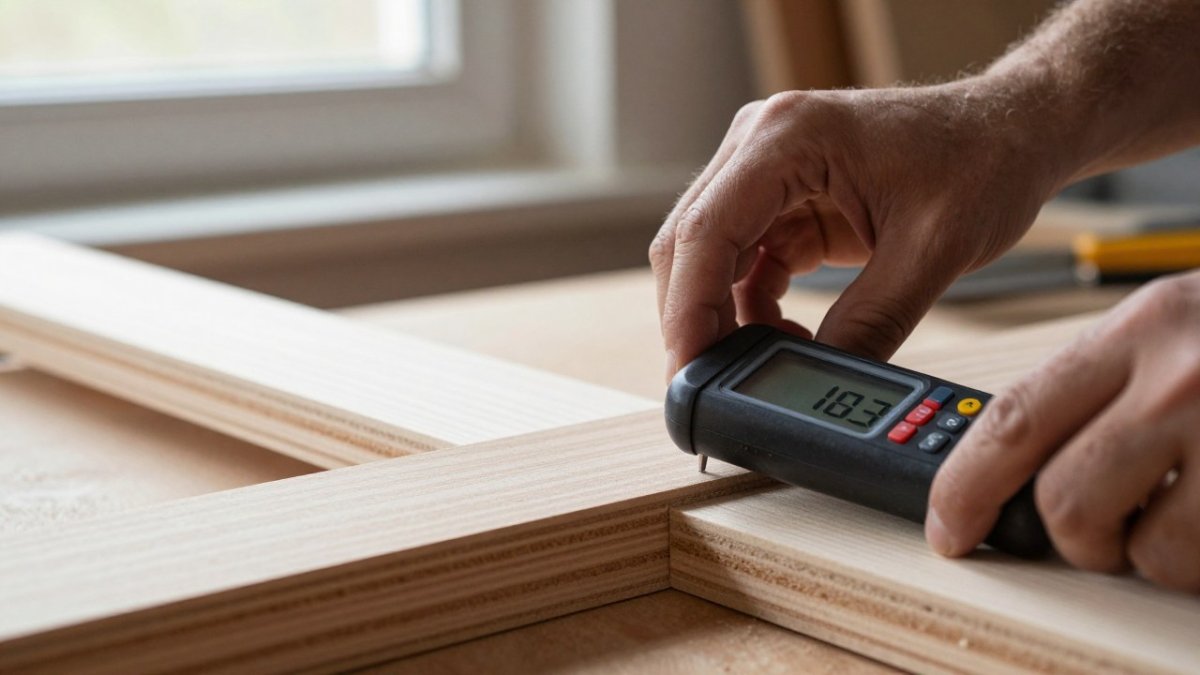
Verification is where buyers get lazy, and it is the single biggest gap between a supplier's claim and what you actually own. A "kiln dried" label on a lift is a claim about the whole lift; a meter reading on the board in your hand is evidence about that board. Ask the yard for a reading on the actual boards you are buying, not a certificate for the whole lift, and test several boards across the stack, since the outer layer dries faster than the core and boards on the outside of a stack can read drier than boards in the middle.
How moisture is measured matters too. A pin-type meter reads at the depth the pins reach, so short pins only tell you about the surface. A pinless meter reads a shallow field and can be thrown off by surface moisture or by species density. The most reliable check is a freshly cut crosscut at the end grain, where the core is exposed, read with a pin meter driven to full depth. The U.S. Forest Service Wood Handbook remains the standard reference on how moisture behaves in wood and why equilibrium matters.
Watch out: a board that reads dry on the face can still be wet at the center, and a board that reads dry in the yard can climb several points after a week in a humid garage. Re-check with a meter after acclimation, not just at purchase.
How to Choose Kiln-Dried Lumber at the Yard
Choosing kiln-dried lumber comes down to four checks you can run in ten minutes. Bring a meter, read the end grain, sight down the length for twist, and ask how the stock was stored after drying.
- Meter three or four boards, not one
- Check end grain and a fresh crosscut
- Sight each board for bow, cup, and twist
- Look for surface checking and case hardening
- Confirm the stock was stored flat and covered
- Ask for the species and the drying date
Species choice matters as much as the drying method. Many options are available, and our wood and stain color options page shows the species and finishes we work with most, from walnut and cherry to red oak and reclaimed stock. A common mistake is buying by price alone and ignoring grain direction; a board with wild grain will move more regardless of how well it was dried.
Local Sourcing and Storage in Central New Jersey
Humid summers and dry, heated winters create a wide swing in equilibrium moisture, which is why kiln dried stock earns its keep in many climates. A board that sits at outdoor humidity in July will shrink noticeably once the heat comes on in January. Buying lumber that was dried and stored under cover shortens the acclimation window.
Once the stock reaches your home in Old Bridge, store it flat on stickers in a dry, covered space, off the concrete, and let it sit for several days before cutting. Keep it out of the garage if that space runs damp. For readers planning a deck build, our deck construction services can help with properly dried framing and decking.
Planning a Project with Kiln Dried Hardwood
Planning around kiln dried stock means ordering slightly more than your cut list calls for, then letting the extra acclimate alongside the rest. Bring the boards into the room where they will live for a few days before milling, and cut joinery only after the meter settles. That single habit prevents most of the callbacks we see on interior work.
If you would rather hand the material selection and build to a team that works with real wood daily, our custom woodwork services can be discussed for your project. When you are ready to move from reading to planning, you can request a free estimate and we will walk your space, talk species, and map the schedule.
Kiln dried hardwood removes the guesswork from a build, but only if the stock is verified and stored correctly before it is cut. PIONEER WOODWERX is a veteran-owned general contractor serving central New Jersey, and we bring that same discipline to every deck, kitchen, bathroom, and basement project we take on, with real wood, custom builds to your specifications, and remodeling tailored to how your family actually lives. Get started with PIONEER WOODWERX and build a space that holds up for decades.
Frequently Asked Questions
What are the disadvantages of kiln drying wood?
Kiln drying uses more energy than air drying, which can affect cost and environmental impact. The rapid process can also cause case hardening or internal stress if not controlled properly, and some species may darken slightly. Kiln-dried hardwood is also more brittle than green wood, so it is less suited to steam bending. For most interior projects, these trade-offs are minor compared with the stability gains.
Is kiln-dried hardwood worth it for indoor furniture and cabinetry?
Yes. Kiln-dried hardwood moisture content is typically brought down to a range that matches indoor conditions, which reduces wood movement after installation. That means less shrinking, warping, and cracking in cabinets, tables, and built-ins. If you are investing in custom woodwork for your home, specifying kiln-dried stock is one of the simplest ways to protect that investment.
Can kiln-dried hardwood still warp or crack?
It can, if it is stored poorly or exposed to very different humidity than it was dried for. Kiln drying reduces the risk but does not make wood immune to moisture. Keep boards flat, off concrete, and covered in a dry space before installation. In homes with wide seasonal humidity swings, acclimate the wood in the room where it will be installed for several days.
How do I choose kiln-dried lumber for a project?
Check the moisture reading with a meter, look for a grade stamp or mill mark, and inspect boards for checks, splits, and case hardening. Ask the yard how the lumber was dried and whether it was equalized. For interior work, look for stock dried to a range suited to conditioned spaces. Buy a little extra to allow for defects and planing.