 Ultimate guide
Why Solid Wood Furniture Lasts for Generations
Last Updated: November 11, 2026
Quick Summary
Solid wood furniture lasts for generations because the wood itself carries the load and can be sanded and refinished as it ages. A well-built piece with sound joinery and correctly kiln-dried lumber can serve a household for 50 to 100+ years.
- Solid wood shows growth rings running through the full thickness on exposed end grain.
- Oak, maple, cherry, and walnut resist dents and hold joints under daily load.
- Wood dried to a stable moisture content before construction moves far less at home.
- Floating panels, breadboard ends, and slotted fastener holes let tops move without splitting.
- The finish usually fails before the wood, so refresh it before wear reaches the grain.
Table of Contents
- The Case for Solid Wood Furniture That Outlives Its Owners
- How to Tell If Furniture Is Solid Wood
- Best Wood for Furniture Longevity
- Joinery and Kiln Drying: The Construction Details That Decide Lifespan
- How Long Does Solid Wood Furniture Last?
- Solid Wood Furniture Care Through Humidity and Seasonal Changes
- Solid Wood Versus Veneer and Engineered Wood
- Planning a Piece That Fits Your Home and Your Family
- Frequently Asked Questions
The Case for Solid Wood Furniture That Outlives Its Owners
A solid hardwood dining table can realistically serve three generations of one family. That is not sentiment: solid wood furniture holds its structure because the wood itself carries the load, and it can be sanded, refinished, and adjusted as it ages. At PIONEER WOODWERX, we build custom pieces in Old Bridge, New Jersey.
Below, we'll show you how to judge a piece before you buy it, which species hold up best, and what care protects an heirloom in a New Jersey home.
Solid wood furniture is furniture built from boards of a single wood species, where the structural parts are cut from solid lumber rather than a thin surface layer bonded to a composite core.
How to Tell If Furniture Is Solid Wood
The fastest check is the end grain on an exposed edge against the grain pattern on the top surface. If the face grain runs in a different direction than the edge grain, you are likely looking at veneer; if they line up continuously, you are probably looking at solid stock.
Checks You Can Do in the Showroom
- Look at the end grain on a drawer side or table edge: solid wood shows growth rings running through the full thickness
- Compare the grain on the top with the grain on the edge: mismatched direction suggests a veneered surface
- Lift one corner of a table: heavy pieces are usually solid, though weight alone never proves it
- Open a drawer and inspect the interior: solid wood drawers show continuous grain on the sides
- Look underneath: solid tops usually show unfinished or lightly finished wood, not a uniform manufactured sheet
- Check for repeating grain patterns across two surfaces, which signals a printed or thin veneer
A common mistake is judging by the label alone. "Solid wood" can legally describe a piece made from short glued offcuts, so ask what the structural parts are made of. For a full walkthrough, see our step-by-step guide on how to identify solid wood furniture.
Best Wood for Furniture Longevity
Hardwoods with tight grain and high density outlast soft, open-grained species in daily use. Oak, maple, cherry, and walnut are the usual workhorses for tables and case goods because they resist dents and hold a joint under load.
| Species | Hardness Character | Grain and Movement | Best Use |
|---|---|---|---|
| White oak | Very hard, dense | Tight, straight grain, stable | Dining tables, benches |
| Hard maple | Hardest of the common species | Fine, closed grain | Tabletops, chairs |
| Black cherry | Medium-hard | Smooth grain, darkens with age | Case goods, dining sets |
| Black walnut | Medium-hard | Open grain, rich color | Statement tables, slab tops |
| Ash | Hard, springy | Pronounced grain | Chairs, frames |
Softwoods like pine dent more easily and show wear faster, fine for painted built-ins, rarely for an heirloom dining table. Match the species to how hard the piece will work.
Joinery and Kiln Drying: The Construction Details That Decide Lifespan
Joinery and moisture content decide whether a well-made piece lasts decades or comes apart in a few seasons. A correctly cut and fitted dovetail or mortise-and-tenon joint is designed to hold under load and wood movement.
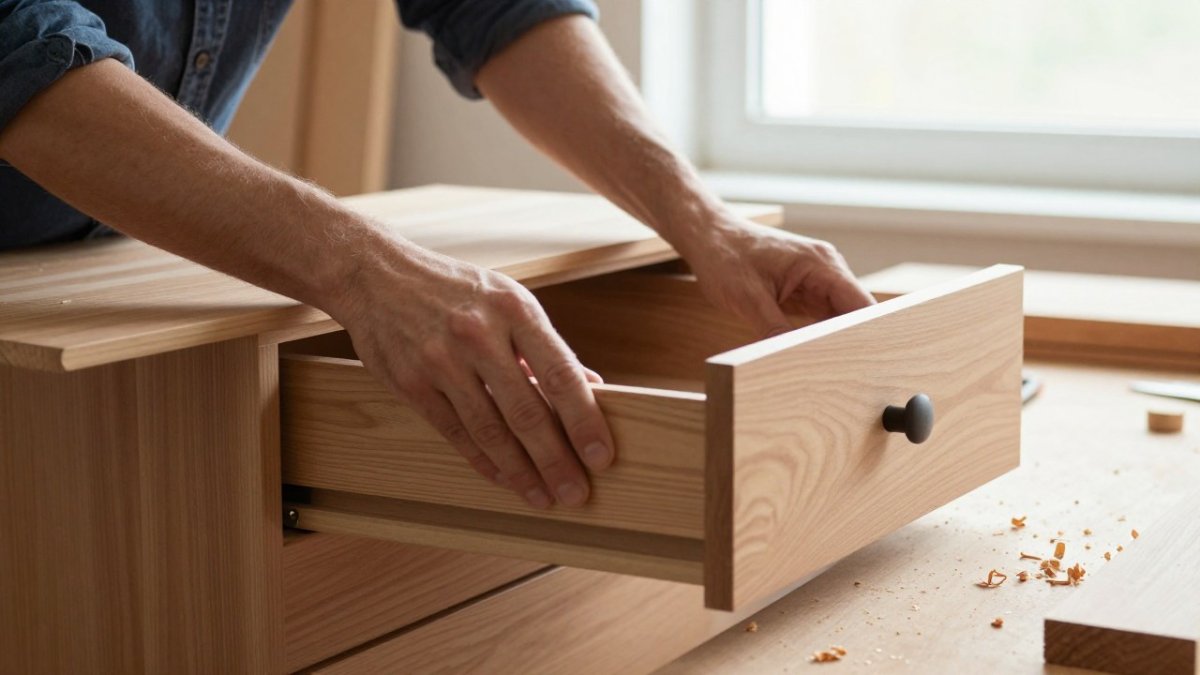
A joint that fits too tightly can split the wood as it moves; one that fits too loosely will rack and loosen. See our fuller buyer's guide on the benefits of kiln dried hardwood.
Why Moisture Content and Wood Movement Matter in New Jersey Homes
Wood expands and contracts with humidity, and Central New Jersey swings hard between humid summers and dry winter heating. Lumber not dried to a stable moisture content will move dramatically in that cycle, which is how tops cup and joints open. Wood movement is physics, not a defect, and good design accounts for it with floating panels, breadboard ends, and joinery that lets the wood breathe.
How Long Does Solid Wood Furniture Last?
A well-built solid wood piece, properly cared for, can serve a household for many decades. The variables that shorten that life are predictable: poor kiln drying, weak joinery, and neglect of the finish. Lifespan is also a design property, two tables cut from the same white oak board can have wildly different service lives depending on how the maker planned for wood movement.
Wood Movement and Furniture Design: The Mechanism That Decides Longevity
Wood is hygroscopic: it takes on and releases moisture from the air, expanding and contracting across the grain far more than along it (Chapter 4: Moisture relations and physical properties of wood). A solid tabletop expands and contracts across its width with seasonal humidity changes. Good design accommodates that movement.
- Floating panels: A solid top or cabinet panel is attached so it can slide slightly within its frame rather than being glued rigidly on all four edges, which is why a well-made dresser top does not split when the panel shrinks in winter.
- Breadboard ends: A tongue-and-groove joint with elongated holes and pegs lets the main field of the top move while the ends stay flat; the pegs are not glued through the full width, which is what allows the movement.
- Slotted or oversized fastener holes: Where a top is screwed to an apron, holes are slotted or drilled slightly oversized so the top can shift without cracking. A maker who drives tight screws in every direction has built in a future split.
- Frame-and-panel construction: Cabinet doors and sides use a floating panel captured in a grooved frame, so the panel expands and contracts independently of the frame.
What Actually Fails First
What most guides miss is that the finish, not the wood, usually fails first. A worn finish lets moisture into the grain unevenly, which is when surface problems begin. A solid wood top can be sanded back and given a fresh protective layer without replacing the piece, the practical difference between solid wood and engineered furniture. The wood itself, if kiln-dried to a stable moisture content and assembled with movement in mind, outlasts everything else in the room.
A Realistic Lifespan Picture
| Construction quality | Typical service life under daily household use |
|---|---|
| Kiln-dried solid hardwood, movement-aware joinery, maintained finish | 50-100+ years |
| Solid hardwood, sound joinery, finish neglected | 20-40 years before major surface work is needed |
| Solid wood with rigid assembly or poorly dried lumber | 5-15 years before splitting or joint failure |
| Veneer over engineered core | Years to a few decades, depending on use |
The single biggest predictor of a long life is not the species name on the sales tag but whether the maker planned for the wood to move. Ask that question before you buy, and the lifespan estimate stops being a guess.
Solid Wood Furniture Care Through Humidity and Seasonal Changes
The single most protective habit is keeping indoor humidity stable year-round. Humid summers and dry winter heating can swing indoor humidity widely. Aim for a steady relative humidity rather than chasing a single number, and avoid placing furniture directly over heating vents or against exterior walls that sweat.
Room-by-Room Care in a New Jersey Home
Dining tables. The table takes the most direct liquid contact of any piece in the house.
Bedroom furniture. Dressers and bed frames often sit against exterior walls in New Jersey homes, where condensation and temperature swings hit hardest.
Pieces near windows or radiators. Direct, harsh sunlight dries and bleaches the surface unevenly, and a radiator or baseboard heater a few feet away creates a much drier microclimate than the rest of the room.
Troubleshooting Common Surface Issues
- Water rings: A white ring from a cold glass is moisture trapped in the finish, not the wood; it often fades within a few days as the moisture escapes, and gentle air circulation helps.
- Light scratches: A fine scratch in the finish often blends when the surrounding area is refreshed with the maker's recommended product. Deep scratches that reach the wood mean the finish needs attention.
- Raised grain: Fuzziness after a spill means moisture reached the wood. Let the area dry fully before adding more liquid.
- Loose joints: A joint that loosens seasonally and tightens again is responding to humidity, not failing. One that stays loose across seasons is a construction issue worth having evaluated.
The Seasonal Routine
- Dust weekly with a soft, slightly damp cloth rather than a dry one that pushes grit around
- Wipe spills promptly and dry the surface
- Keep pieces out of direct, harsh sunlight
- Refresh the finish on the maker's recommended schedule
- Use felt pads under objects that could scratch, and coasters under every drink
- Run a hygrometer in the main rooms and adjust with humidification or dehumidification as the season turns
Our team published solid wood dining table care steps that walk through the seasonal routine in more detail. The short version: stable humidity, gentle cleaning, and a finish refresh before wear reaches the wood.
Solid Wood Versus Veneer and Engineered Wood
Veneer and engineered wood have real places in a home, and solid wood is not always the right call.
Where solid wood wins decisively is anything that takes daily load and needs to last: dining tables, benches, bed frames, and chairs, the pieces that get leaned on, sat on, and moved from house to house. For a direct comparison, see our breakdown of solid wood vs particle board furniture.
| Factor | Solid Wood | Veneer | Engineered Core |
|---|---|---|---|
| Lifespan under daily load | Decades to a century | Years to a few decades | Years |
| Refinishable surface | Yes, repeatedly | Once at most | No |
| Response to humidity swings | Moves predictably | Can lift at edges | Stable in panels |
| Best use | Tables, chairs, beds | Cabinets, built-ins | Painted casework |
Planning a Piece That Fits Your Home and Your Family
The piece that lasts generations is the one designed for how your family actually lives.
At PIONEER WOODWERX, we build with 100% real wood to client specifications, and we are a veteran-owned general contractor serving Central New Jersey. You can explore our custom furniture service to see how a commission comes together.
The challenge with heirloom furniture is that most of what is sold today is not built to be handed down.
Frequently Asked Questions
What makes solid wood furniture last for generations?
Three things carry a piece across decades: solid hardwood rather than veneer or particleboard, joinery that holds under daily load, and lumber dried to a stable moisture content before assembly. Solid wood can be sanded and refinished when the surface wears. Add routine care around humidity and well-built solid wood can last a very long time.
How can you tell whether furniture is made from solid wood?
Look at the end grain on an unfinished edge, under a tabletop, or inside a drawer side. Solid wood shows growth rings and a grain pattern that continues from the face around the corner. Open a drawer and check the interior: solid wood is consistent throughout, while veneer shows a thin face layer over a different core. Also check weight and how the top is attached, since solid wood tops are usually fixed with fasteners that allow the wood to move.
Which wood species are best for long-lasting furniture?
Hardwoods with dense grain hold up best: white oak, hard maple, cherry, and walnut are the common choices for heirloom work. White oak resists wear and takes a finish well, maple handles dents better than most, and cherry and walnut develop a patina as they age. Softer species like pine can last too, but they show dents sooner and suit bedrooms and low-traffic pieces more than a family dining table.
How should you care for solid wood furniture over time?
Keep indoor humidity steady, since dry winter air causes more cracking and splitting than daily wear does. Wipe spills promptly, dust with a soft cloth, and keep pieces out of direct sun. Reapply a protective finish such as oil or wax on the schedule the maker recommends, and address scratches early with a light sanding and touch-up rather than letting them collect moisture.