 Listicle
What Wood Is Best for a Custom Bathroom Vanity?
Last Updated: October 29, 2026
Quick Summary
White oak and maple handle a humid bathroom best for the money, while teak resists water better than any species on the list. For a bathroom vanity, pick the species for the doors and face frames, then let the builder specify a plywood box and dovetailed hardwood drawers around it.
- White oak wins on moisture resistance; maple wins on hardness for bathroom vanities.
- Teak's natural oils make it the most water-tolerant wood in the lineup.
- Birch gives you a real hardwood face at a lower material cost than oak or maple.
- Particle board boxes are the number one reason builder-grade vanities fail in bathrooms.
- Run the exhaust fan during and for 15-20 minutes after every shower.
Table of Contents
- What Wood Types Work Best for Custom Bathroom Vanities?
- Oak vs Maple Bathroom Vanity: Grain, Hardness, and Humidity
- Teak and Walnut: Moisture Resistance and Rich Color
- Birch Bathroom Vanity: The Budget-Friendly Hardwood
- Bathroom Cabinet Materials: Solid Wood, Plywood Core, and Engineered Options
- Bathroom Vanity Wood Finish: Sealing and Protecting Your Wood
- Wood Movement, Ventilation, and Central New Jersey Bathroom Conditions
- Choosing Your Vanity Wood with a Custom Builder
- Frequently Asked Questions
What Wood Types Work Best for Custom Bathroom Vanities?
Choosing among the best wood types for custom bathroom vanities comes down to four things: moisture exposure, grain character, hardness, and budget. Choosing among the common hardwoods for a bathroom vanity comes down to moisture exposure, grain character, hardness, and budget.
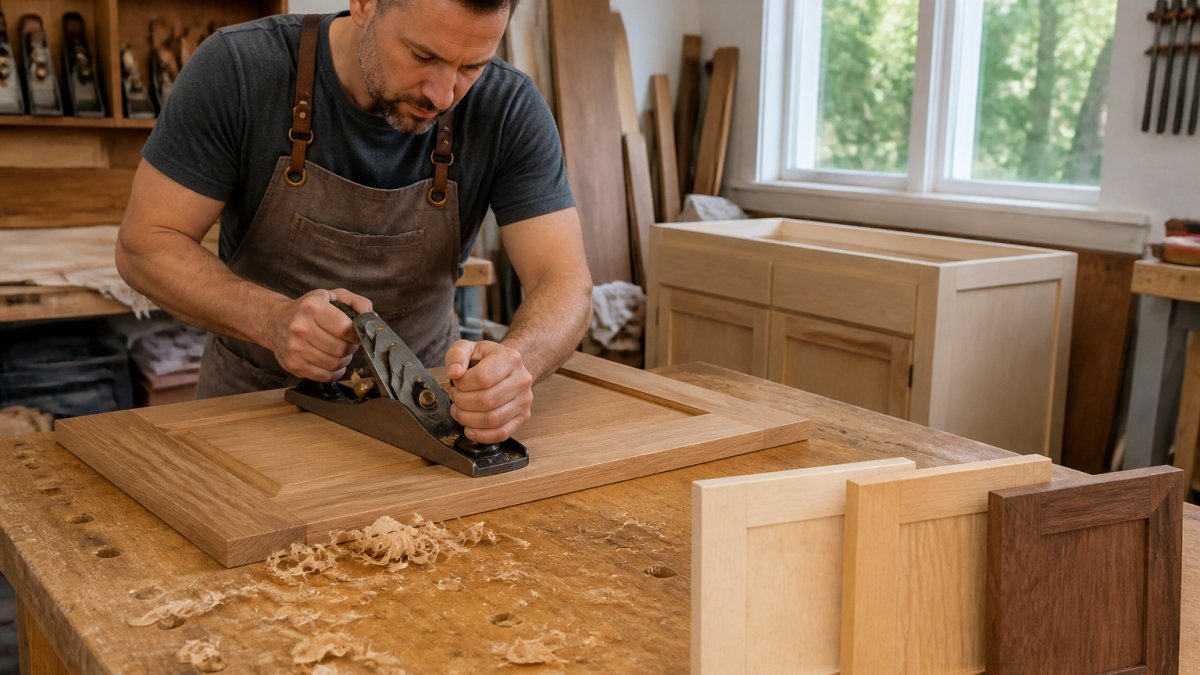
The short answer: white oak and maple handle a humid bathroom best for the money. Teak resists water better than any species on this list. Walnut and cherry give you the richest color. Birch and pine keep the project affordable.
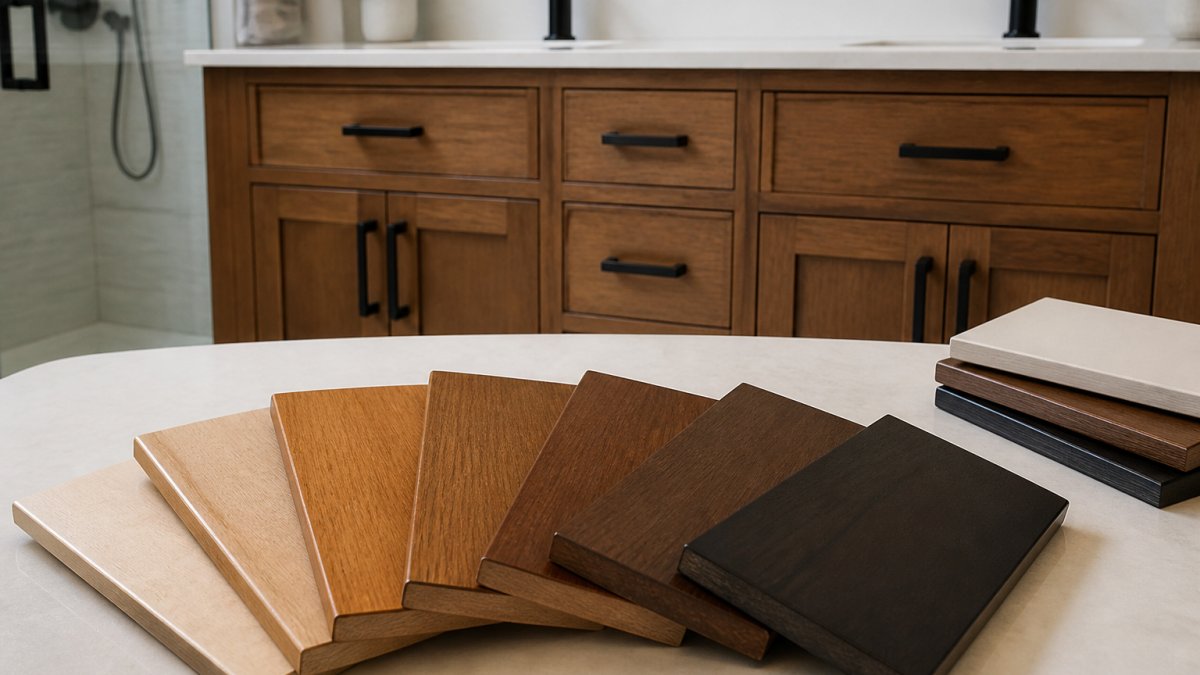
A vanity is a wet-room cabinet, not living room casework. You can also browse our wood and stain color options to see the species and finishes we offer.
| Wood | Moisture Resistance | Hardness | Grain and Color | Best For |
|---|---|---|---|---|
| White oak | High | High | Open, straight grain; pale tan | Most bathrooms |
| Maple | Moderate | Very high | Fine, closed grain; creamy | Painted or clear finishes |
| Teak | Very high | High | Golden brown, oily | Wet rooms, heavy splash |
| Walnut | Moderate | High | Rich chocolate, flowing grain | Statement vanities |
| Cherry | Moderate | Medium-high | Smooth, warm red-brown | Traditional rooms |
| Birch | Moderate | Medium-high | Tight, even grain | Budget builds |
| Pine | Low | Low | Knotty, honey-toned | Guest baths, rustic looks |
Oak vs Maple Bathroom Vanity: Grain, Hardness, and Humidity
White oak wins on moisture; maple wins on hardness.
Grain tells the rest of the story. Oak has an open, pronounced grain that reads rustic or mission-style, while maple's fine, quiet grain suits a clean, painted, or modern look.
For a busy family bathroom, oak is often a sound choice. For a powder room with light traffic and a crisp white palette, maple is a reasonable pick.
Teak and Walnut: Moisture Resistance and Rich Color
Teak is the most water-tolerant wood in this lineup. Its natural oils make it slow to absorb moisture, which is why it has a long history in boats and spas.
Walnut is the opposite proposition. It brings deep chocolate tones and dramatic, flowing grain that makes a vanity the focal point of the room. It is not as water-resistant as teak, so it depends on a good finish and reasonable ventilation.
Birch Bathroom Vanity: The Budget-Friendly Hardwood
A birch bathroom vanity gives you a real hardwood face at a lower material cost than oak or maple. Birch has a tight, even grain that takes paint beautifully and stains more predictably than maple.
Where birch falls short is hardness and moisture tolerance. It dents more easily than maple and does not shrug off steam the way oak does.
Bathroom Cabinet Materials: Solid Wood, Plywood Core, and Engineered Options
A custom vanity is a stack of decisions: door and drawer front material, cabinet box material, joinery, and countertop support.
Here is how the parts break down for a typical custom bathroom vanity:
- Doors and drawer fronts: Solid hardwood for visible faces, white oak, maple, walnut, cherry, and teak all work. Solid stock allows a builder to shape a profile and sand a crisp edge on a bathroom door.
- Face frames: Solid hardwood, usually matching the doors so the finish reads consistently, giving the box a stiff front edge and a clean line where doors close.
- Cabinet box (carcass): Cabinet-grade plywood resists warping and holds screws and hinges better than solid wood in a humid room. For a deeper comparison, see our guide to solid wood vs plywood for custom built-in cabinets. Look for AC-grade plywood with a smooth face and a stable hardwood veneer; it need not match the door species.
- Drawer boxes: Hardwood sides (maple and birch are common) with a plywood or solid bottom. Dovetail joinery is a common benchmark for drawers that see heavy daily use.
- Countertop support: Stone, quartz, or solid surface tops need a flat, stiff substrate. A plywood deck set into the box spreads the load and keeps the top from flexing; solid wood is a poor substrate because it moves across the width of the vanity.
Solid wood vs. engineered wood, part by part
- Solid hardwood: Best for doors, drawer fronts, and face frames, durable and stable when finished properly, but prone to movement across wide panels. Wide solid-wood doors are prone to seasonal movement, which can show up as sticking or gapping.
- Hardwood plywood: A plywood core with a hardwood veneer. Stable, strong, and the standard for quality cabinet boxes; cross-laminated plies resist the humidity swings a solid panel cannot.
- Engineered wood (MDF, particle board): Stable in dry rooms, but quality varies widely. MDF is fine for a painted door in a powder room; particle board swells when wet and has no place in a bathroom cabinet box.
Veneer vs. solid: how to verify what you are buying
A "solid wood vanity" can mean several things. Ask the builder three questions before you sign:
- Are the doors and drawer fronts solid stock or veneered? (Solid stock is standard for custom bathroom doors; veneer is common on large flat panels and on budget lines.)
- What is the cabinet box made of, plywood, MDF, or particle board? Ask for the grade (AC-grade plywood is the benchmark).
- Are the drawer boxes dovetailed hardwood, or stapled? Dovetail joinery is the tell for a box built to last in a wet room.
How species choice changes the build
Species is not just a color decision, it changes how the vanity is built. White oak and maple hold a crisp edge and take a clear finish well, suiting shaker and flat-slab doors.
The practical takeaway: pick the species for the doors and face frames, then let the builder specify the box and drawer construction around it.
Bathroom Vanity Wood Finish: Sealing and Protecting Your Wood
A bathroom vanity wood finish is the barrier between your cabinet and the steam, splashes, and humidity of a bathroom. No species survives a wet room without one.
- Conversion varnish or a catalyzed lacquer for the best moisture and chemical resistance
- A marine-grade or spar urethane for a durable, water-resistant topcoat
- Multiple coats on all sides, including the inside of the cabinet and the underside of the top
The mistake we see most is a beautiful finish on the outside and bare wood inside the cabinet box. Moisture finds the unprotected side, and the panel moves.
Color choice matters too. If you are still deciding on a stain, our guide to what color finish is best for my space walks through matching wood tone to floors, walls, and cabinets.
Wood Movement, Ventilation, and Central New Jersey Bathroom Conditions
Wood moves. Every species expands and contracts as humidity rises and falls, and a bathroom is the most demanding room in the house for that cycle.
Why wood moves
Wood is hygroscopic: it takes on moisture from the air and releases it, swelling across the grain as it does.
What the Old Bridge climate does to a vanity
Old Bridge and the surrounding Middlesex, Monmouth, and Union County towns have humid summers and dry, heated winters.
Installation clearances that prevent warping and sticking
A few practices keep seasonal movement from turning into cracks and sticking doors:
- Leave a small gap, roughly 1/16 to 1/8 inch, between doors and the face frame, and between adjacent doors, so seasonal swelling does not bind them.
- Use plywood cores for wide panels instead of solid wood, and keep solid-wood doors to a sensible width.
- Set the vanity off exterior walls where condensation forms, or insulate and vapor-manage that wall before the cabinet goes in.
- Shim the cabinet level and secure it to the wall studs, not just the drywall, so the box does not rack.
- Seal every surface you can reach, including the inside of the cabinet box and the underside of the top, so moisture does not find an unprotected side.
Ventilation: the cheapest durability upgrade
Run the exhaust fan during and for 15-20 minutes after every shower. A fan sized to the bathroom (roughly 1 CFM per square foot of floor area) clears the steam before it settles into the cabinet (Bathroom Exhaust Fans).
What this means for species choice
Choosing Your Vanity Wood with a Custom Builder
The right species is the one that fits your bathroom's moisture load, your design, and your budget, in that order.
Pioneer Woodwerx is a veteran-owned general contractor serving Central New Jersey. We build with 100% real wood, build to your specifications, and specialize in bathroom renovations and aging-in-place modifications. We are based in Old Bridge.
When you are ready to choose your wood, you can request a free consultation to talk through your vanity.
Frequently Asked Questions
What type of material is best for a bathroom vanity?
There is no single best material, but solid hardwood in the cabinet frame and doors paired with a plywood-core box is the most reliable combination for a bathroom vanity. Oak, maple, and teak handle humidity well, while birch and poplar keep budgets in check. Avoid particleboard cores in wet areas because they swell when water reaches the edges. For a custom build, ask which species is used for the frame, doors, and drawer fronts, and how each surface is sealed.
Is birch wood good for bathroom vanities?
Yes, a birch bathroom vanity is a practical choice when the cabinet is properly sealed. Birch is a hardwood that takes paint and stain evenly, and it costs less than oak or maple, which makes it popular for painted vanities. The trade-off is that birch shows dents more easily than harder species and its grain is subtle, so it suits painted or light-stained designs better than bold natural finishes. Keep the seams and edges sealed and run the exhaust fan during showers.
Is oak or maple better for a bathroom vanity?
It depends on the look and hardness you want. In the oak vs maple bathroom vanity comparison, maple is harder and resists dents better, with a fine, even grain that suits painted and natural finishes. Oak is slightly softer but has open grain and strong character, and white oak in particular resists moisture well. Choose maple for a clean, modern look and oak for a traditional or rustic vanity with visible grain.
What is the best waterproof finish for wood in a bathroom?
No finish makes wood fully waterproof, but a bathroom vanity wood finish built from a penetrating sealer followed by multiple coats of a moisture-resistant topcoat gives the best protection. Film-forming finishes such as conversion varnish or a catalyzed lacquer resist steam and splashes well on cabinets, while marine-grade varnish suits teak. Recoat high-splash areas near the sink every few years and wipe up standing water promptly to keep the finish intact.
Does solid wood work well for bathroom vanity cabinets?
Solid wood works well for doors, drawer fronts, and face frames, but the cabinet box is usually better built with hardwood plywood. Solid wood expands and contracts with humidity, so using it for wide flat panels can lead to warping. A plywood core with a solid wood frame gives stability and strength. In a well-ventilated bathroom with a sealed finish, a solid wood vanity can last for decades.
A bathroom vanity is a daily-use piece of furniture in the wettest room in your home, and the wood you choose decides how it looks and holds up a decade from now. Pioneer Woodwerx builds custom vanities in 100% real wood, tailored to your bathroom and your family's needs, with the project management to keep the job on schedule. Get started with Pioneer Woodwerx and choose a vanity built to last.