 How-to
7 Steps to Install Handrails on Concrete Steps
Last Updated: November 9, 2026
Quick Summary
Installing handrails on concrete steps means drilling pilot holes with a hammer drill and carbide-tipped masonry bit, cleaning the dust out, then setting anchors sized to your base plate. Match the anchor to the concrete and the load, keep holes back from the step edge, and torque each anchor to the manufacturer's stated value.
- A hammer drill with a carbide-tipped masonry bit is the core tool; a standard drill will not work.
- Measure handrail height from the tread nosing, not the middle of the step.
- A common layout sets the rail 2 to 3 inches in from the open edge of the stair.
- Wedge anchors hold best in sound concrete; epoxy wins in cracked or crumbling concrete.
- Vacuum and blow out each hole before setting anchors, since dust kills anchor grip.
Table of Contents
- Tools for Installing a Handrail on Concrete
- Handrail Placement for Outdoor Stairs
- How to Anchor a Handrail to Concrete
- Choosing Outdoor Handrails for Concrete Steps and Landing
- Drilling and Setting Base Plates on Concrete Steps
- Troubleshooting Spalling Concrete and Pull-Out Strength
- Schedule Your Handrail Installation Consultation
- Frequently Asked Questions
Tools for Installing a Handrail on Concrete
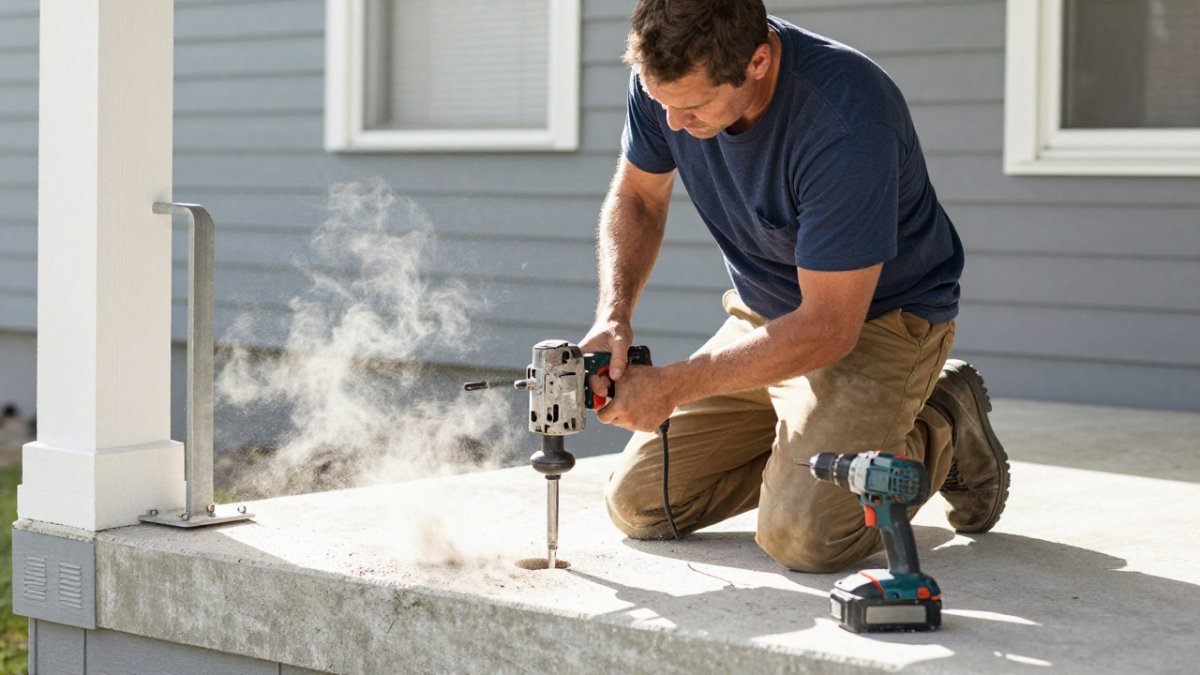
Installing handrails on concrete steps starts with the right kit, and the right kit for handrails on concrete starts with the drill. A hammer drill with a carbide-tipped masonry bit is the non-negotiable core of the job. A standard drill will spin and smoke and get you nowhere.
Here is a typical tool list for a concrete stair job:
- Hammer drill with masonry drill bits
- Masonry drill bit sized to your anchor (usually matched to the bolt diameter)
- Socket set and torque wrench
- Carbide-tipped coring bit for larger posts
- Vacuum or dust extraction attachment
- 4-foot level and a torpedo level
- Tape measure, pencil, and masking tape
- Safety glasses, hearing protection, and a dust mask
- Anchors: wedge anchors, sleeve anchors, or epoxy adhesive
- Base plates, post brackets, and the railing sections
Two items get skipped most often: the dust mask and the vacuum. Concrete dust is fine and pervasive, and drilling overhead without extraction means you breathe it. The CDC guidance on crystalline silica exposure explains why that matters on even a small job.
Buy one spare bit. Masonry bits dull fast in old, hard concrete, and a dull bit is the number one reason a pilot hole wanders off mark.
Handrail Placement for Outdoor Stairs
Placement decides whether a handrail feels natural or fights you every time you use it. Get the height and the gap right before you drill a single hole, because concrete does not forgive a misplaced anchor.
Handrail height is the first number to settle. Confirm the handrail height, graspability and permit requirements with your local building department before you cut anything, because a rail that fails the final inspection is a rail you take apart.
The graspable profile matters as much as the height. Choose a rail shape a hand can comfortably wrap around, and check the size requirements with your local building department.
The clearance gap is the number most DIYers miss. Leave enough clear space between the rail and the wall or post so a hand can wrap around it without scraping knuckles.
For outdoor stairs, add these placement rules:
- Run the rail continuously over the full flight, plus a short extension at the top and bottom. Extend the rail past the top and bottom of the flight as your local code requires.
- Keep the rail parallel to the stair slope. A rail that steps down in segments is harder to grip and fails the continuity requirement in most inspections.
- Set posts closely enough on long runs that the rail does not flex under a hand load.
- Set the rail back from the stair edge so it does not crowd the tread. A common layout is 2 to 3 inches in from the open edge of the stair, which keeps the rail inside the stair width without eating usable tread.
- Check the baluster gap against your local code requirements for guards.
If you are planning this as part of a larger safety update, our aging in place home modification checklist covers what else to look at while you are already working. And if the project is part of a bigger plan, how to plan aging in place modifications helps you sequence the work.
Watch out: measuring height from the tread instead of the nosing is the most common placement error, and it leaves the rail too low to feel secure. The nosing is the front edge of the tread, and every code measurement runs from that point, not from the middle of the step.
How to Anchor a Handrail to Concrete
Anchoring a handrail to concrete comes down to matching the anchor to the concrete and the load. There is no single best anchor.
Here is how the main options compare:
| Anchor Type | Best For | Typical Pull-Out Behavior | Watch Out For |
|---|---|---|---|
| Wedge anchor | Solid, uncracked concrete | Highest holding in sound concrete; load concentrates at the expansion clip near the bottom of the hole | Can crack weak or thin concrete; loses grip fast in cracked slabs |
| Sleeve anchor | Concrete of mixed or uncertain quality | Moderate holding; load spreads along the sleeve length | Lower pull-out than wedge in dense concrete |
| Epoxy adhesive | Cracked concrete, close-to-edge holes | Load spreads across the full bonded length; most forgiving in poor concrete | Needs clean, dry holes and full cure time before loading |
| Tapcon screw | Light loads, small base plates | Low; relies on thread engagement in the concrete | Not for heavy rail posts or any load a person grabs |
| Lead shield anchor | Older or softer concrete | Moderate initial hold, but can loosen under vibration | Can work loose over time on stair traffic |
Pull-out strength is the number that decides safety, and it scales with embedment depth and concrete strength. A wedge anchor holds best in dense, sound concrete because the expansion clip bites into the hole wall near the base.
A residential stair rail post should be anchored with an anchor rated for the load, such as wedge anchors or epoxy-set threaded rod, with embedment that follows the anchor manufacturer's published table for the concrete strength you have.
Edge distance is the silent failure point. Drilling too close to the edge of a step concentrates stress and can blow out the corner under load. Follow the minimum edge distance published by your anchor manufacturer.
Match the anchor to the base plate mounting holes, drill the pilot hole to the anchor's stated diameter (not the next size up), and clean the hole before you set anything.
Watch out: over-torquing a wedge anchor is as dangerous as under-tightening it.
Choosing Outdoor Handrails for Concrete Steps and Landing
Outdoor handrails for concrete steps and landing need to survive New Jersey weather, which means freeze-thaw cycles, summer humidity, and road salt tracked onto the steps. Material choice is where most of the long-term satisfaction lives.
The realistic options:
- Powder-coated steel: strong, low maintenance, and the coating resists rust well.
- Wrought iron: classic look, very strong, but heavier and needs periodic attention to the finish.
- Aluminum: light and rust-proof, good for coastal humidity, but it can feel less solid in the hand.
- Wood: warm and traditional, but it needs refinishing and it weathers faster than metal outdoors.
Corrosion resistance separates a rail that lasts from one that stains your concrete within a few seasons. Powder-coated steel and aluminum are both common choices for outdoor rails.
For a deeper comparison of railing materials and how they hold up, our guide to the best deck railing materials for durability walks through the trade-offs.
The one drawback with powder-coated steel: if the coating chips at an anchor point, rust can start in that spot. Touch up any chip right away.
Drilling and Setting Base Plates on Concrete Steps
Drilling and setting base plates is the step that decides whether the whole rail is solid or wobbly. Get the holes right and the rest is straightforward.
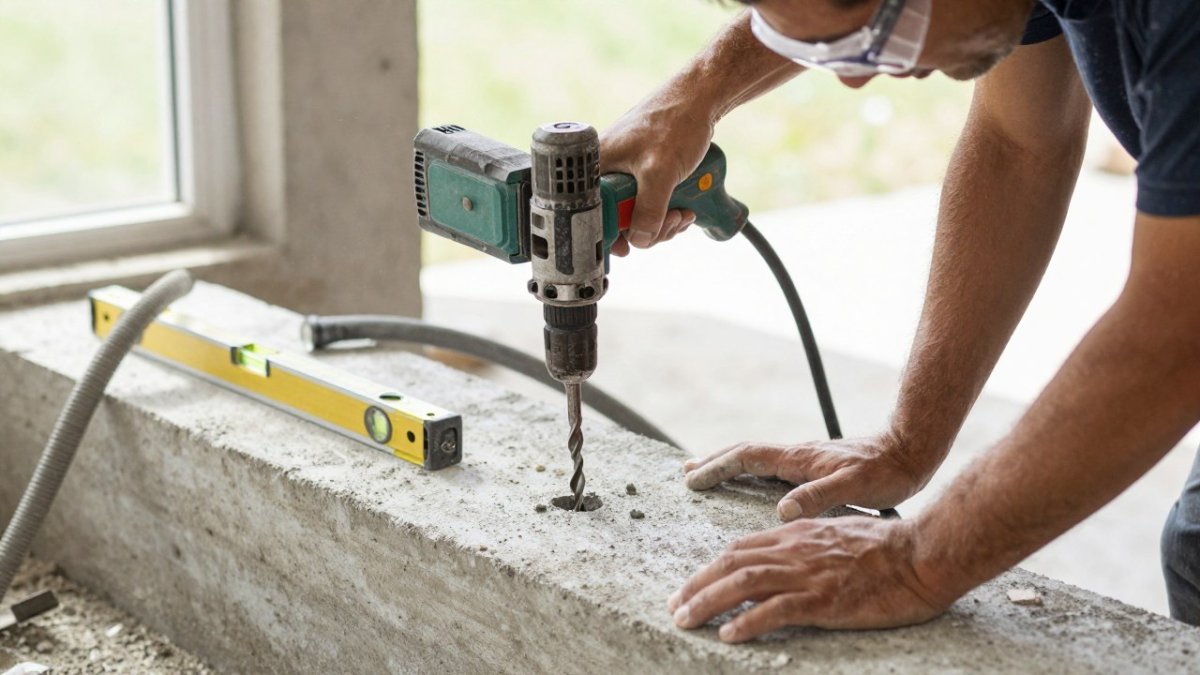
Follow this sequence:
- Mark the plate locations. Set each base plate in position, mark the mounting holes with a pencil, and double-check spacing with a tape measure.
- Check for obstructions. Confirm no rebar or embedded conduit sits where you plan to drill.
- Drill the pilot hole. Use a masonry bit matched to the anchor diameter. Hold the drill steady and keep it perpendicular to the surface.
- Extract the dust. Vacuum the hole and blow it out. Clean holes hold anchors.
- Set the anchor. Tap the wedge or sleeve anchor in, or inject epoxy and insert the threaded rod.
- Mount the base plate. Seat the plate over the anchors and hand-tighten the nuts.
- Level and plumb. Check the plate with a level in both directions before final torque.
- Torque to spec. Tighten to the anchor manufacturer's stated torque. Over-torquing cracks concrete.
Skipping the level check between steps 6 and 7 is how rails end up leaning. Set the plate, check it, adjust, then torque.
Troubleshooting Spalling Concrete and Pull-Out Strength
Crumbling or spalling concrete is the problem most how-to videos skip, and it is the one that ruins an otherwise good install. If the concrete around your anchor crumbles, the anchor has nothing to grip.
Signs to look for before you drill:
- Surface flaking or pitting on the steps
- Hollow sound when you tap the concrete
- Visible cracks running through the tread or riser
- Exposed or rusting rebar
If you find spalling, do not just drill and hope. Options that protect pull-out strength:
- Shift the anchor location to sound concrete, if the plate allows
- Use epoxy adhesive to bond the anchor across a wider area
- Add a larger base plate to spread the load over more concrete
- Address the concrete first if the damage is deep, before mounting anything
Pull-out strength drops in cracked or spalled concrete, even with a good anchor, so test one anchor before committing to the full set.
Watch out: drilling too close to the edge of a step concentrates stress and can blow out the corner. Keep anchors back from the edge and follow the anchor maker's edge-distance guidance.
Schedule Your Handrail Installation Consultation
A handrail is a small project with an outsized safety payoff. If the drilling, anchoring, and code checks feel like more than you want to take on, that is exactly the kind of work we do.
At PIONEER WOODWERX, we are a veteran-owned general contractor serving Central New Jersey, and we tailor each remodeling job to the home.
If you are weighing a broader safety update, our aging-in-place remodeling in Central New Jersey service can help you plan the work. When you are ready to move, you can request a free consultation.
A wobbly rail is worse than no rail, because it teaches the people who need it not to trust it. Get the anchoring and placement right, or hand it to someone who will. PIONEER WOODWERX can assess your steps, recommend the right rail and anchor setup, and install it to code. Get started with PIONEER WOODWERX and give your household a handrail that holds.
Frequently Asked Questions
Can you put a railing on concrete steps?
Yes. Concrete steps accept handrails through surface-mounted base plates held by wedge anchors, sleeve anchors, or epoxy-set threaded rods. The key is choosing an anchor rated for the concrete's condition and drilling a clean pilot hole with a hammer drill and masonry bit. If the concrete is sound, a railing can be installed securely. Crumbling or spalling concrete needs attention first, since anchors rely on solid material to hold.
How do I anchor a handrail to concrete?
Mark the base plate holes, then drill pilot holes with a hammer drill and masonry bit sized to your anchor. Clear the dust with a vacuum or bulb blower. Set wedge or sleeve anchors and torque them to the manufacturer's spec, or inject epoxy adhesive and insert threaded rod for the strongest hold. Check plumb and level before final tightening. Anchoring a handrail to concrete comes down to clean holes and the right anchor for the load.
What are the best outdoor handrails for concrete steps?
Powder-coated steel and wrought iron hold up best outdoors, offering corrosion resistance and low upkeep. Aluminum works for coastal or humid areas. Wood rails suit a custom look but need sealing against moisture. Choose a rail that meets handrail height and graspability rules under your local building code, and pick a finish suited to freeze-thaw cycles.
How do you choose handrail placement for outdoor concrete stairs?
Place the rail so the top sits at the height your local code requires above the stair nosing. Keep a consistent gap from the wall and extend the rail the full run of the stairs plus the landing. Confirm the rail is continuous and graspable, with no sharp ends. Check with your local building department before drilling, since permit and height rules vary by municipality.