 How-to
What Are the Signs of High Quality Handcrafted Wood Furniture?
Last Updated: November 5, 2026
Quick Summary
The signs of high quality handcrafted wood furniture appear in the details: grain that continues around edges, dense weight when you lift a corner, and honest joinery like mortise-and-tenon and dovetails. Read the grain, feel the weight, and inspect the joinery in that order to rule out printed surfaces, hollow cores, and weak joints.
- Tap the top with your knuckles: solid wood gives a dull, dense sound, while a hollow rattle suggests a thin skin over a hollow core.
- Mortise-and-tenon joints are the benchmark for case goods and chairs because they resist racking and twisting.
- A quality drawer bottom sits captured in a groove in the sides rather than stapled to the underside.
- Compare solid wood furniture brands on species, joinery, finish, and warranty terms, not on photos.
- Refresh oiled finishes with a matching oil once or twice a year, and keep cherry and walnut out of direct sun.
Table of Contents
- Why Handcrafted Wood Furniture Outlasts Mass-Produced Pieces
- How to Identify Quality Wood Furniture: A Step-by-Step Walkthrough
- Solid Wood, Veneer, or Engineered Wood: Telling Them Apart in a Finished Piece
- Hardwood Species and What Each One Means for Your Home
- An In-Store Inspection Checklist for Handcrafted Wood Furniture
- Is Solid Wood Furniture Made in USA Worth Seeking Out?
- How to Compare Solid Wood Furniture Brands Before You Commit
- Caring for Handcrafted Wood Furniture by Species and Finish
- Frequently Asked Questions
Why Handcrafted Wood Furniture Outlasts Mass-Produced Pieces
The signs of high quality handcrafted wood furniture show up in the details: real grain, honest joinery, and weight that surprises you.
Mass-produced pieces hide their shortcuts under laminate and glue. Handcrafted wood furniture hides nothing.
That matters more than ever. Below, we'll walk through the exact steps we use to judge a piece, from grain to drawer glides.
But first, here's what most guides get wrong: they tell you to look for "solid wood" and stop there. Solid wood alone proves nothing.
How to Identify Quality Wood Furniture: A Step-by-Step Walkthrough
Learning how to identify quality wood furniture comes down to three checks: read the grain, feel the weight, and inspect the joinery. Do them in that order and few bad pieces will fool you. The sequence matters because each check rules out a different class of shortcut, printed surfaces, hollow cores, and weak joints, so you are not wasting time on a piece that already failed an earlier test.
Step 1: Read the Grain and End Grain
Start with your eyes. Look at the top surface, then at the end grain on a leg or edge.
- Matching grain: On solid wood, the grain pattern continues around edges and corners. Follow a single board from the top around to the side; the lines should flow, not stop at a seam.
- End grain: Real wood shows tight growth rings on cut ends. Veneer shows a thin line over a different core, and the rings on the face will not align with the rings on the end.
- Natural variation: Knots, mineral streaks, and color shifts are normal. Perfectly identical panels usually mean printed or engineered surfaces.
- Cathedral patterns: Flat-sawn boards show arching cathedral grain; quarter-sawn boards show straight, tight lines. A maker who mixes cuts deliberately is showing you the wood, not hiding it.
Watch out: a veneered panel can pass a quick glance because the face is real wood, tilt it toward a light and check the edge seam before you trust it.
Step 2: Tap, Feel, and Lift the Piece
Tap the top with your knuckles. Solid wood gives a dull, dense sound. A hollow, rattling tap often means a thin skin over a hollow core.
Then feel the surface. A smooth finish should feel even, with no plastic drag under your fingers. Run a hand along the underside, too. Makers who care about construction quality finish the parts you never see.
Finally, lift one corner. Weight and solidity are honest signals. Heavy pieces usually carry thicker stock and sturdier frames.
Step 3: Check the Joinery and Drawer Construction
Turn the piece over.
Frame joinery. Look at how rails meet legs.
Dovetail joints. Interlocking wedge-shaped pins on drawer corners signal real drawer construction.
Corner blocks and braces. Look for glued and screwed blocks that add stability at the corners of case goods.
Drawer glides. Wood-on-wood runners or quality side mounts beat flimsy plastic tracks.
Stability test. Set the piece on a level floor and press one top corner.
Open every drawer and door. They should close smoothly and sit flush. Gaps and wobble point to rushed assembly.
Solid Wood, Veneer, or Engineered Wood: Telling Them Apart in a Finished Piece
Veneer is a thin slice of real wood glued over plywood or particle board. It can look good, and it can last, but it is not solid wood.
Here is how to tell them apart once a piece is finished:
- Edges: Solid wood shows continuous grain on the edge. Veneer shows a seam or a different core underneath.
- Corners: Rounded, wrapped corners usually mean veneer. Solid wood is cut and shaped, not wrapped.
- Repetition: Identical grain on two panels means a printed or engineered surface.
- Weight: Engineered panels feel light for their size.
For a deeper look at how these materials compare, see our guide on solid wood vs particle board furniture.
Hardwood Species and What Each One Means for Your Home
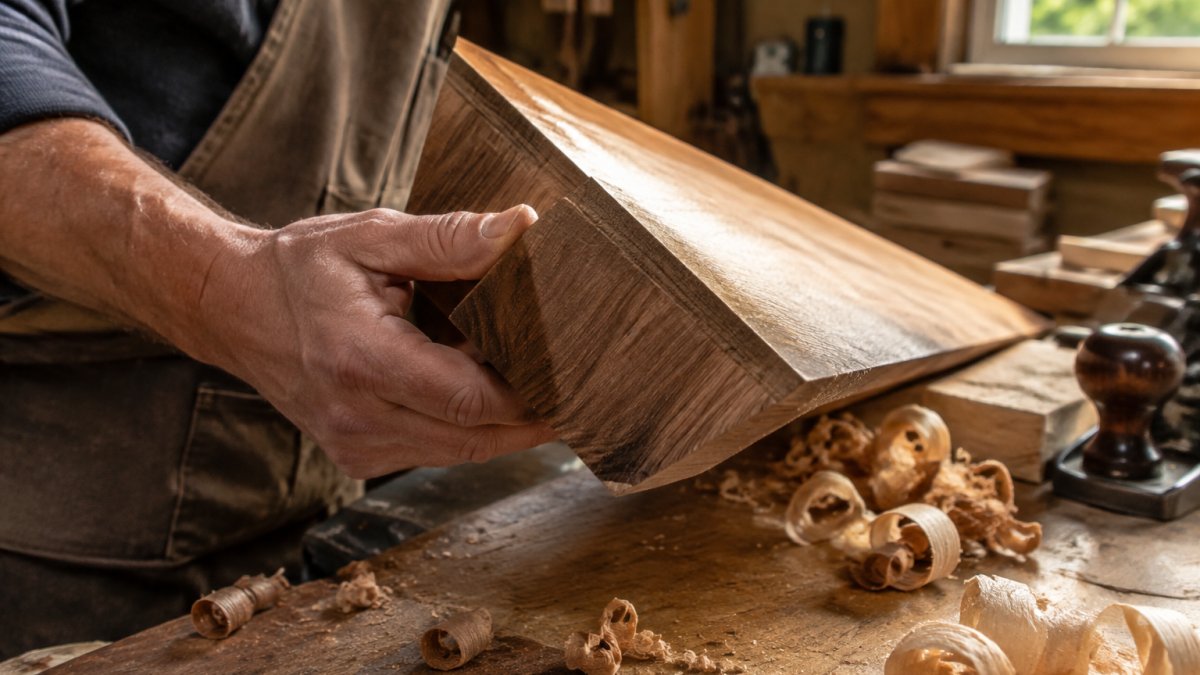
Species choice drives how a piece looks, wears, and ages. Cherry darkens with light. Maple stays pale and takes a beating. Walnut brings deep brown tones and strong grain. Oak shows bold grain and holds up to daily use.
Here is a quick comparison:
| Species | Look | Best For |
|---|---|---|
| Oak | Bold, open grain | Dining tables, bookcases |
| Maple | Pale, fine grain | Kitchens, home office furniture |
| Cherry | Warm, darkens over time | Dining furniture, accents |
| Walnut | Deep brown, strong grain | Statement tables, built-ins |
Hardwood species differ in more than color. Dense woods resist dents better, which matters in busy family homes. Softer woods show wear sooner but cost less.
If you want to see how these species look with different stains, browse our wood and stain color options.
An In-Store Inspection Checklist for Handcrafted Wood Furniture
Bring this checklist to any showroom. It takes about ten minutes per piece.
- Check end grain on legs and edges for real growth rings
- Tap the top and listen for a dense, dull sound
- Lift one corner and judge the weight
- Open every drawer and confirm smooth travel
- Look for dovetail joints at drawer corners
- Feel the underside for a finished surface
- Inspect corners for veneer seams or wraps
- Compare grain patterns across panels for repeats
Is Solid Wood Furniture Made in USA Worth Seeking Out?
Often, yes. Domestic makers tend to use thicker stock, clearer species labeling, and joinery you can inspect.
That said, "made in USA" is a claim, not a guarantee. Ask what species is used, how the frame is joined, and what finish is applied. A maker who answers plainly is a maker worth trusting.
We welcome questions like these. For a side-by-side look at handcrafted versus factory pieces, read our custom furniture vs mass produced comparison.
How to Compare Solid Wood Furniture Brands Before You Commit
Compare solid wood furniture brands on four things: species, joinery, finish, and warranty terms. Not on photos. The gap most buyers fall into is treating a brand's marketing language as evidence, the useful comparison is between what a brand will put in writing and what it will not.
- Species disclosure: Good brands name the exact wood, white oak, black walnut, hard maple, and will tell you which parts are solid and which are not. Vague labels like "hardwood" or "wood solids" hide cheap stock. Ask directly: "What species is the top, and what species are the drawer sides?" A brand that answers with a species name is giving you something you can verify.
- Joinery details: Look for dovetails, mortise-and-tenon joints, and corner blocks, and ask where each is used. A brand that says "dovetail drawers" but cannot tell you whether the drawer bottom is grooved or stapled is telling you the joint is a marketing point, not a construction standard.
- Finish type: Ask whether the finish is sprayed lacquer, oil, or conversion varnish, and how it handles spills. Conversion varnish and catalyzed lacquer are more resistant to water rings and household cleaners than an oil finish; an oil finish is easier to refresh but needs more attention. Neither is automatically better, the trade-off is durability versus ease of upkeep.
- Lead times: Ask for a written schedule and what happens if it slips. A brand that gives a range and explains what drives it is more reliable than one that promises a date it cannot control.
- Service area: Local makers can measure, deliver, and adjust on site. Ask whether delivery includes placement and whether the maker will come back if a door settles after a season.
A common mistake is comparing price tags alone. Price reflects species, labor, joinery, finish, and customization, so a lower tag usually means a thinner stock, a simpler joint, or a faster finish, not a better deal.
Ask each brand the same five questions and compare the answers side by side. Brands that answer plainly, in writing, are the ones worth a showroom visit.
Caring for Handcrafted Wood Furniture by Species and Finish
Care depends on species and finish, not on one universal routine. Here are general guidelines:
- Oiled finishes: Refresh with a matching oil once or twice a year.
- Lacquered or varnished finishes: Wipe with a damp cloth and mild soap. Avoid harsh cleaners.
- Cherry and walnut: Keep out of direct sun to slow uneven color shifts.
- Maple and oak: Use coasters and felt pads. These species show rings and dents sooner.
- All species: Keep indoor humidity steady and wipe spills promptly.
For a full routine, follow our solid wood dining table care steps.
Frequently Asked Questions
What are the signs of high-quality handcrafted wood furniture?
Start with the grain: on handcrafted wood furniture, the pattern should continue across drawer fronts and around corners, and end grain on legs and tops should match the species. Then check the joinery, since dovetail joints and mortise-and-tenon construction signal a builder who expects the piece to last. Lift a chair or drawer and feel the weight, tap the underside for a solid rather than hollow sound, and run your hand over the finish for evenness. Uneven grain, stapled joints, and lightweight panels are the usual warning signs.
How can you tell if furniture is made from solid wood?
Look at the end grain on an unfinished surface such as the underside of a tabletop or the inside of a leg. Solid wood shows growth rings and a grain pattern that continues through the thickness of the board. Veneer shows a thin edge with a visible seam where the sheet meets the core. Also check whether the grain repeats identically on two adjacent surfaces, which points to a printed or laminated finish rather than real wood.
Which joinery methods indicate well-made wood furniture?
Dovetail joints on drawer boxes, mortise-and-tenon joints on frames, and doweled or biscuited panels with room to move are the marks of careful construction. Dovetails interlock so the drawer resists pulling apart under load, and you can usually see them at the back corners of a drawer. Staples, nails driven through face grain, and glued butt joints are faster and cheaper, and they tend to loosen as the wood expands and contracts through New Jersey's seasonal humidity swings.
Is solid wood furniture made in USA better quality?
Origin alone does not guarantee quality, but domestic makers are easier to verify. You can ask which species was used, where it was milled, and who built the piece, and a small shop will usually answer directly. Solid wood furniture made in USA also tends to come with clearer information about construction and finish than imported flat-pack lines. Compare the grain, joinery, and finish first, then use the maker's location and willingness to answer questions as a tiebreaker.
Buying handcrafted wood furniture in Old Bridge and the surrounding New Jersey towns should not feel like a gamble. At PIONEER WOODWERX, we build with 100% real wood, craft each piece to your specifications, and handle projects from a single table to a full kitchen or aging-in-place remodel. Our veteran-owned team serves homeowners across Middlesex, Monmouth, and Union Counties. Get started with PIONEER WOODWERX and request a free consultation to plan a piece built to last.