 blog
Is a Curbless Shower Worth It for Resale? 7 Things to Know
Last Updated: November 2, 2026
Quick Summary
A curbless shower is worth it for resale when your likely buyer values a modern, barrier-free primary bath and you have years before listing, since you recover only part of the project cost in the sale price. If you're selling within months and the existing shower is sound and clean, it's the safer spend.
- A curbless entry makes a primary bathroom feel larger and more modern, and it photographs well for listings.
- Recessing the shower floor often means adjusting the subfloor and sometimes the joists to match finished floor heights.
- Estimate the buyer-appeal premium from nearby sold comps with updated primary baths, and treat it as a range.
- A feature that shortens days-on-market or reduces negotiation credits has real dollar value even if the sale price is unchanged.
- Skipping the waterproof membrane or rushing the slope is the most common way a curbless shower becomes a leak.
Table of Contents
- Curb vs. Curbless Shower: What Buyers Actually See
- Curbless Shower Pros and Cons for Homeowners
- Curbless Shower System: What Goes Into the Build
- Wheelchair-Accessible Bathroom and Aging-in-Place Value
- Resale Value and Return on Investment: A Realistic Payback Calculation
- Old Bridge and Middlesex County Resale Evidence
- Feasibility, Permits, and Moisture Management in Existing Homes
- Planning Your Curbless Shower Consultation
- Frequently Asked Questions
Curb vs. Curbless Shower: What Buyers Actually See
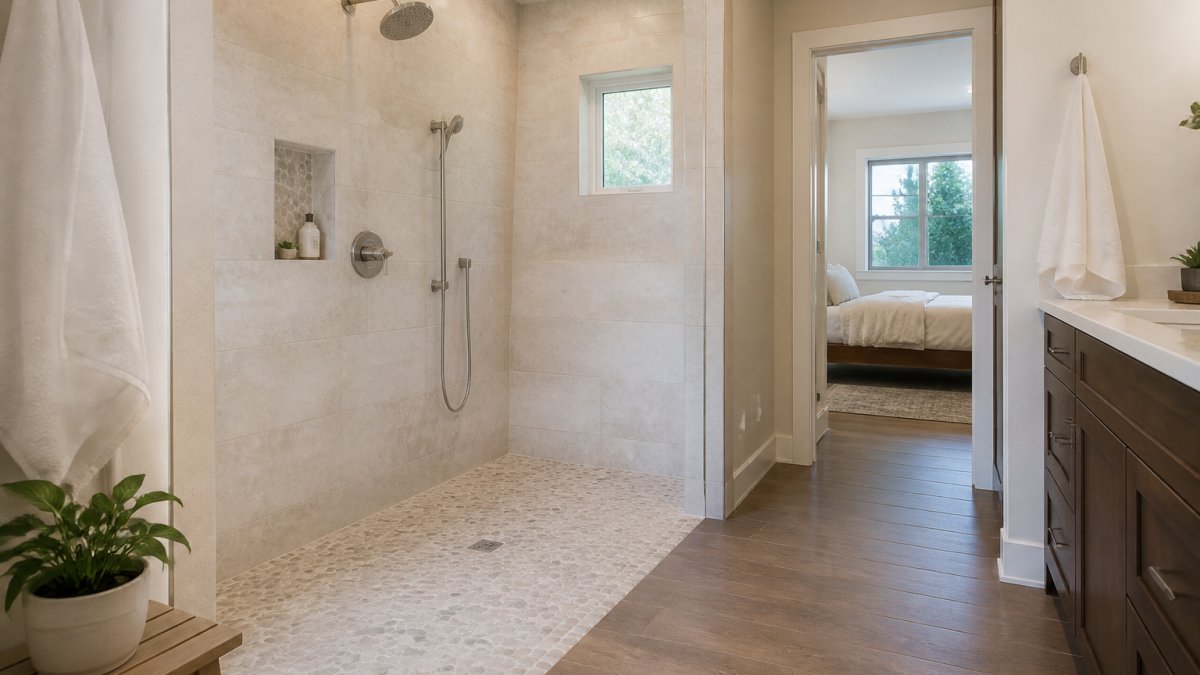
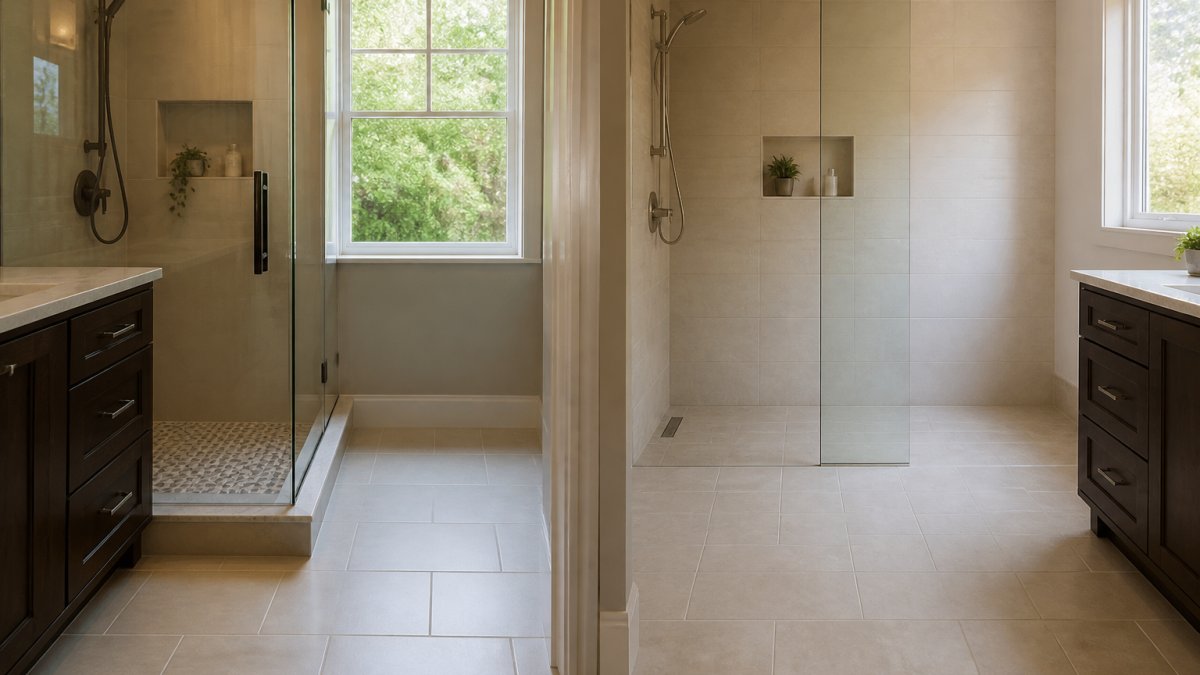
Whether a curbless shower is worth it for resale depends on one thing most sellers never ask: does the buyer walking through your bathroom see a feature they want, or a project they'll inherit? A curbed shower is the familiar default, a raised threshold that keeps water in and reads as standard. A curbless shower, sometimes called a barrier-free entry, removes that lip entirely and lets the tile floor run straight into the shower zone. This decision sits at the intersection of design, safety, and what a future buyer will pay for.
What buyers notice first is sightline. A curbless entry makes a primary bathroom feel larger and more modern, and it signals that the home was built with care. What they notice second, often at the same showing, is the floor itself. Is it level? Does water pool? Is the slope right? Those questions decide whether the feature reads as a selling point or a worry.
Curbless Shower Pros and Cons for Homeowners
The curbless shower pros and cons come down to appeal versus execution. On the plus side, a barrier-free entry is easier to step into, safer underfoot for anyone with balance concerns, and visually cleaner. It photographs well, which matters in a market where listings live or die on images. On the minus side, it demands more from the build: precise slope, a well-chosen drain, and disciplined waterproofing. Get those right and it's a genuine asset. Cut corners and you're handing a buyer a leak risk.
The honest limitation is that not every floor structure cooperates. Homes on a slab and homes with wood joists solve the level-change problem in different ways, and the solution drives the complexity and the labor.
- Best for: households planning to age in place, and sellers targeting buyers who value a modern primary bath
- Skip if: you're selling within a few months and the existing shower is sound and clean
Curbless Shower System: What Goes Into the Build
A curbless shower system is more than a missing lip. It's a coordinated set of parts working together: a recessed shower floor, a waterproof membrane across the whole wet zone, a linear drain or point drain positioned to catch water before it reaches the dry floor, and a carefully set floor slope that moves water to the drain without a visible dip. The tile sits on top, but the system underneath is what earns the resale premium.
This is where most guides get vague, and where the real cost lives. Recessing the shower floor often means adjusting the subfloor, and sometimes the joists, so the finished floor height matches the rest of the bathroom.
Wheelchair-Accessible Bathroom and Aging-in-Place Value
For older homeowners and the adult children helping them plan, a curbless shower is often the entry point to a broader wheelchair-accessible bathroom. The shower is the hardest obstacle to clear, so removing the threshold unlocks the rest of the room's potential. Grab bars, a comfort-height toilet, and a clear turning radius build on that base. This is aging-in-place work in its most practical form.
Buyers in this segment read accessibility as foresight, not limitation. A bathroom that works for a grandparent today works for a buyer's parent tomorrow. If you're mapping out the full room rather than just the shower, our guide on how to make a bathroom wheelchair accessible walks through the whole layout step by step.
Resale Value and Return on Investment: A Realistic Payback Calculation
Here's the part most articles skip: return on investment on a curbless shower is not a fixed number you can look up, and no honest contractor will hand you a percentage. It's a calculation you build yourself, and the inputs are specific to your home, your buyer, and your timeline. The gap between what the feature adds to buyer appeal and what the same buyer would have paid for the home with a standard shower is your realistic upside, and it is rarely the full project cost.
A transparent way to frame the decision is to separate three numbers that sellers usually blur together:
- Project cost: the full scope to build a curbless shower correctly, subfloor modification, waterproof membrane, drain selection, slope, tile, glass, and labor. On a wood-framed floor this is typically the smaller end of the range; on a slab where concrete must be opened to recess the pan, it climbs. A written scope is worth requesting before you compare options.
- Buyer-appeal premium: what a curbless primary bath actually adds in your price band. You estimate this from nearby sold comps with updated primary baths versus comparable homes with dated baths, not from the invoice. Treat the premium as a range, not a point.
- Time-to-sale value: a feature that shortens days-on-market or reduces negotiation credits has real dollar value even if the sale price is unchanged. A buyer who was already searching for a barrier-free bath is less likely to ask for a concession at inspection.
A realistic scenario looks like this: a seller in a Middletown or Old Bridge colonial with a dated primary bath weighs a curbless build against the comps.
- Long runway (several years before listing): the safety and design value accrues to you first; any resale recovery is a bonus.
- Short runway (selling within months): the feature only pays if your likely buyer is actively searching for it, otherwise a sound, clean existing shower is the safer spend.
- Uncertain timeline: get a feasibility read and a written scope before committing, so you can compare the project against comps rather than against a feeling.
For a grounded sense of what renovation scope means locally, our aging in place renovation cost guide for Old Bridge, NJ puts the surrounding numbers in context.
The article breaks the payback question into three separate numbers sellers usually blur together.
| Item | What it is | Note |
|---|---|---|
| Project cost | Full scope to build a curbless shower correctly | Written scope worth requesting before comparing options |
| Buyer-appeal premium | What a curbless primary bath adds in your price band | Estimate from nearby sold comps, treat as a range |
| Time-to-sale value | Value of shorter days-on-market or fewer negotiation credits | Real dollar value even if sale price is unchanged |
| Long runway | Several years before listing | Safety and design value accrues to you first |
| Short runway | Selling within months | Only pays if your likely buyer is actively searching |
| Uncertain timeline | Timeline not yet decided | Get a feasibility read and written scope first |
Old Bridge and Middlesex County Resale Evidence
Local evidence is more useful than national averages. In Old Bridge and across Middlesex County, the resale case for a curbless shower is best built from local signals.
Comparable-listing logic. Buyers shopping the same price band in Old Bridge, East Brunswick, Sayreville, and Middletown compare primary baths directly.
Household fit. Middlesex County has a steady mix of multigenerational households, older homeowners planning to stay put, and adult children helping parents plan. For those buyers, a barrier-free entry isn't a luxury, it's a requirement they were already searching for, which means your listing reaches them before a standard shower would.
Aging-in-place context. Many homeowners intend to age in place rather than downsize, and that shapes what they look for in a primary bath. A curbless shower with grab-bar blocking and a clear turning radius reads as foresight to that segment, not limitation.
The strongest local case is therefore household fit plus comparable positioning, not a promised premium. Before you commit, walk your own comps: pull recent sold listings in your town with updated primary baths, note how they were priced and how fast they moved, and compare that against a written scope for your project.
Feasibility, Permits, and Moisture Management in Existing Homes
Existing-home feasibility is the question that decides everything else. Before committing, a feasibility check should review the subfloor, the joist direction, the slab or crawlspace condition, and the drain routing. Some homes accept a curbless design with modest floor modifications; others need more invasive work to recess the shower floor and keep floor heights aligned.
Permits matter too. Bathroom renovations that alter plumbing, framing, or the shower pan typically require local permits and inspections, and the exact requirements are set by the local building department. Moisture management is the other non-negotiable. A waterproof membrane, correct slope, and splash control at the open edge keep water where it belongs. Watch out: skipping the membrane or rushing the slope is the single most common way a curbless shower turns into a leak that shows up months later in the ceiling below. For the accessibility standards that separate a truly usable design from a typical one, see our comparison of ADA bathroom requirements vs residential standards.
Planning Your Curbless Shower Consultation
The decision gets much easier once someone qualified looks at your actual floor. Before you commit to a curbless build, get a feasibility read on the subfloor, the drainage, and the permit path, and weigh that against your selling timeline. If you're also comparing the shower against a tub or a standard walk-in, our breakdown of a walk-in shower vs a bathtub for elderly safety and accessibility helps you choose the right target before you spend.
PIONEER WOODWERX is a veteran-owned general contractor serving Central New Jersey, with dependable project management and craftsmanship tailored to each home. The business specializes in aging-in-place remodeling. If a curbless shower is on your list, request a free consultation to discuss your project.
Frequently Asked Questions
Does a curbless shower increase resale value?
It can improve buyer appeal, especially for aging-in-place buyers and households with mobility needs, but it does not guarantee a dollar-for-dollar return. The gain depends on the home's price tier, the quality of the waterproofing and tile work, and whether the local buyer pool values accessible design. A curbless shower is best treated as a selling feature that widens the buyer pool rather than a guaranteed value booster.
What are the downsides of a curbless shower?
The main downsides are higher installation complexity and cost, since the subfloor often needs to be recessed or the floor raised, and waterproofing must be done correctly to prevent leaks. Some homeowners also find that water splashes beyond the shower zone more easily, so a longer glass panel or linear drain placement matters. In a small bathroom, the floor slope and drain layout can limit layout options.
Is a curbless shower a good choice for aging in place?
Yes. A barrier-free entry removes the step that causes trips and falls, and it allows a wheelchair or shower chair to roll in without a threshold. Pair it with a linear drain, slip-resistant tile, and blocking for grab bars to create a wheelchair-accessible bathroom. For households planning to stay in the home long term, the safety benefit often outweighs the resale calculation.
Can a curbless shower work in a small bathroom?
It can, but the drain and slope design matter more in tight spaces. A linear drain along one wall often gives a cleaner slope than a center point drain, and it can reduce the floor height change needed. A contractor should check joist direction and subfloor depth before committing, since some small bathrooms need the floor raised rather than recessed.
A curbless shower can be worth it for resale, but only when the build is right and the buyer fit is real. That takes a contractor who checks the floor before promising the finish. Get started with PIONEER WOODWERX and build a bathroom that serves your family now and appeals to the next one.