 Comparison
Which Kitchen Cabinet Material Is Right for Your Home?
Last Updated: November 14, 2026
Quick Summary
The best kitchen cabinet materials for Old Bridge homes are plywood for cabinet boxes and solid wood or painted MDF for doors. Plywood holds fasteners well and resists racking, which matters in New Jersey's humid summers and dry winters. Near sinks and dishwashers, specify sealed plywood boxes and edges, since steam from each cycle is the hardest test for any material.
- Plywood is generally regarded as holding fasteners better than particleboard or MDF.
- Solid wood moves most with humidity, so frame-and-panel doors suit it better than wide slabs.
- MDF swells at unsealed edges, so factory-sealed edges matter for painted doors.
- Particleboard is the least forgiving; once moisture reaches its core, it does not return to shape.
- Ask contractors to name the exact material and grade for each cabinet component in writing.
Table of Contents
- Why Cabinet Material Matters More Than Style Alone
- Solid Wood Kitchen Cabinets: Natural Character and Long-Term Durability
- Plywood Kitchen Cabinets: Moisture Resistance and Structural Strength
- MDF Kitchen Cabinets: Smooth Finishes and Engineered Consistency
- Kitchen Cabinet Materials Pros and Cons Side by Side
- Choosing Cabinet Materials for Old Bridge Homes and Humid Kitchens
- Booking Your Kitchen Consultation in Old Bridge
- Frequently Asked Questions
Why Cabinet Material Matters More Than Style Alone
Most homeowners in Old Bridge spend weeks choosing cabinet colors, hardware and door profiles. Far fewer think hard about what the cabinet boxes are actually made of. That is a mistake, because the material behind the door decides how the cabinets hold up under daily use, humidity and the weight of a full kitchen. A beautiful door on a weak box still fails, so the material deserves attention first.
The four materials you will most often see quoted are solid wood, plywood, MDF and particleboard. Each one behaves differently. Some resist moisture well, some hold screws firmly, and some are mainly a way to keep costs in check. Knowing those differences helps you ask the right questions before you sign a contract.
Solid Wood Kitchen Cabinets: Natural Character and Long-Term Durability
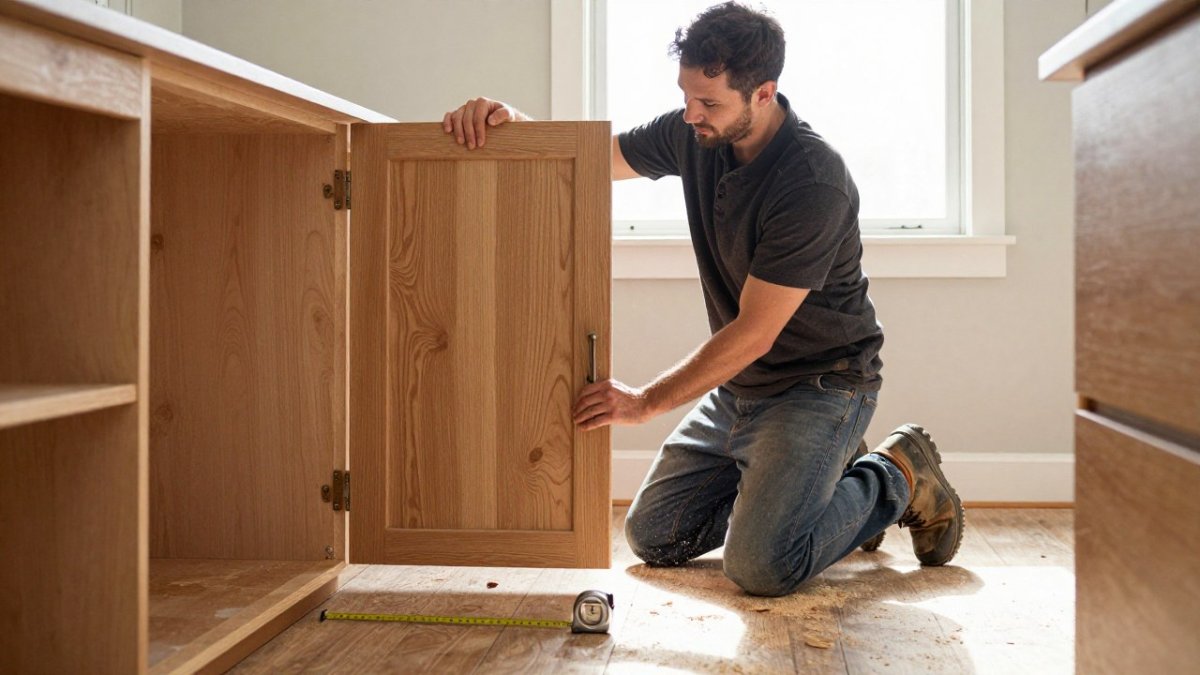
Solid wood kitchen cabinets are made from real lumber. The grain, color variation and natural knots give each door a character that no printed surface can copy. Homeowners who plan to stay in their house for many years often choose solid wood for exactly this reason.
Durability is the main argument in its favor. Read more about why solid wood furniture lasts for generations. A well-built solid wood door can be refinished or repainted several times over its life, which is harder to do with laminated or veneered surfaces. The tradeoff is cost and movement. Wood expands and contracts with humidity, so the joinery and finish need to be done properly. Ask any builder how they handle seasonal movement before you commit.
Plywood Kitchen Cabinets: Moisture Resistance and Structural Strength
Plywood is built from thin layers of wood glued together with the grain alternating direction. That cross-layering is what gives it strength. Plywood is generally regarded as holding fasteners better than particleboard or MDF, and as being less prone to racking, the sideways twisting that can loosen a cabinet box over time. For a direct side-by-side look at how plywood and solid wood hold up structurally, see solid wood vs plywood for custom built-in cabinets.
For Old Bridge kitchens, moisture resistance is the point that matters most. A kitchen near a dishwasher or sink sees steam and splashes every day. Plywood boxes tend to stay square and tight under those conditions. Pricing depends on the plywood grade and cabinet specification, so ask for a written quote that names the exact grade used for the box and the doors.
MDF Kitchen Cabinets: Smooth Finishes and Engineered Consistency
Medium-density fiberboard, or MDF, is an engineered panel made from wood fibers bonded with resin. Its main advantage is a very smooth, uniform surface. That makes it a good base for painted doors, because paint goes on evenly without showing wood grain.
MDF has limits. It does not hold screws as firmly as plywood, and it can swell if water sits on the edges for long. To see how it differs from cheaper particle board, read engineered wood vs particle board key differences. Many reputable guides list MDF alongside melamine, stainless steel and sealed plywood as materials that handle kitchen conditions well, though they do not rank them against each other. We suggest using MDF for doors and decorative panels, and asking for plywood or solid wood for the cabinet boxes where strength matters most.
Kitchen Cabinet Materials Pros and Cons Side by Side
Use this table to compare the main options at a glance, then read the notes below it, because the box and the door are usually made from different materials and each one is judged on different criteria. The ratings are general observations from common cabinet construction practice, not laboratory measurements, so confirm the exact specification with your contractor.
| Material | Best Strength | Main Weakness | Best Use | Moisture Behavior | Fastener Holding |
|---|---|---|---|---|---|
| Solid wood | Long-term durability, can be refinished or repainted | Moves with seasonal humidity, highest cost | Doors, face frames, visible trim | Good when sealed on all six sides; end grain needs a finish | Excellent |
| Plywood | Cross-layered strength, resists racking | Grade and core quality vary widely between suppliers | Cabinet boxes, drawer boxes, shelves | Good; edges must be sealed or banded | Very good |
| MDF | Smooth, uniform surface for paint | Swells at unsealed edges, weaker screw holding | Painted doors, decorative panels | Fair; moisture-resistant grades help but do not make it waterproof | Fair |
| Particleboard | Lowest cost | Poorest moisture resistance and fastener holding of the four | Budget boxes in low-moisture zones only | Poor; swells and crumbles once water reaches the core | Poor |
Construction quality matters as much as the material name. A plywood box built with glued and doweled joints, a solid back panel and a properly banded edge will outperform a solid wood box assembled with staples. When you compare quotes, ask three questions: how the box is joined, what the back panel and shelf material are, and whether the drawer boxes are dovetailed or stapled. Dovetail drawer boxes and full-extension, soft-close slides are features some buyers look for when comparing cabinetry grades.
Semi-custom versus custom changes the material conversation. Semi-custom lines generally offer a fixed menu of box materials and door styles, while custom work can specify the box material zone by zone.
Finishes change how each material performs. Matte and low-sheen finishes hide scratches and fingerprints better on painted MDF and solid wood alike, while high-gloss finishes show every smudge and are harder to touch up on site.
Watch out: a quote that names only "plywood" or "MDF" without the grade, thickness or core type leaves room for substitution, so ask for the specification in writing before you sign.
Particleboard is the cheapest of the four and is common in budget cabinetry. If you are choosing particleboard to save money, ask where it will sit and how well it will be sealed.
Choosing Cabinet Materials for Old Bridge Homes and Humid Kitchens
Old Bridge sits in central New Jersey, where summers run humid and winters bring dry indoor air from heating systems. That seasonal swing is a significant stress on kitchen cabinetry. Wood and wood-based panels absorb moisture and expand in summer, then release it and contract in winter. Over several seasons, a box that was not built for that movement will show it as sticking doors, gaps at the seams, or loose hinges.
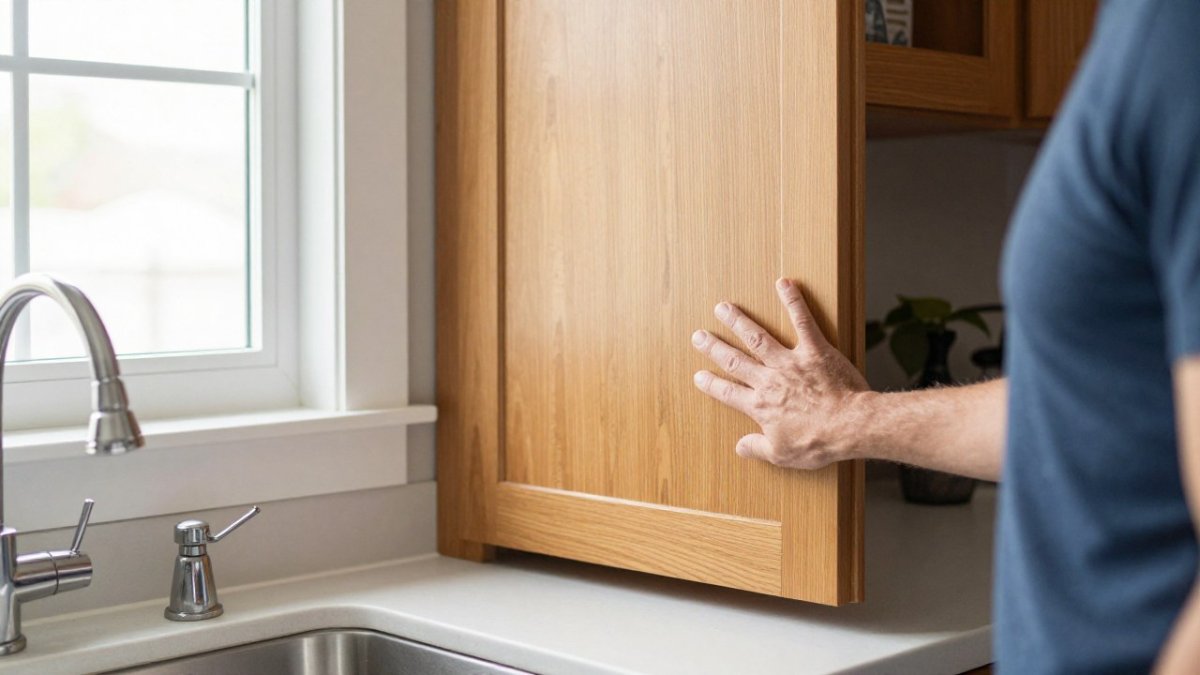
How each material reacts to the New Jersey seasonal swing. Plywood tends to handle this cycle well among the engineered options because its cross-layered construction distributes movement in both directions. MDF is stable in the panel face but vulnerable at any unsealed edge, so a painted MDF door with a factory-sealed edge holds up far better than a site-cut panel with a raw edge. Solid wood moves the most of the four, which is why door construction, frame-and-panel rather than a single wide slab, matters more than the species name. Particleboard is the least forgiving; once moisture reaches the core, it does not return to its original shape.
Match the material to the moisture zone. Kitchens have wet zones and dry zones, and the smartest approach is to specify materials by zone rather than one material for the whole room. Near the sink, dishwasher and range, use plywood boxes with sealed edges and solid wood or painted MDF doors with factory finishes. On upper cabinets away from the range, and on pantry or island storage, the material choice is driven more by budget and style than by moisture. Base cabinets around a dishwasher deserve the most attention because steam escapes every cycle.
Maintenance for busy households. Families with children and pets should prioritize scratch and moisture resistance over showroom gloss. Matte and low-sheen finishes hide scuffs better than high-gloss, and textured or wood-grain laminates on door faces resist visible scratching better than flat painted surfaces. Wipe spills promptly at seams and edges, keep a dehumidifier or exhaust fan running during humid stretches, and avoid soaking cabinet surfaces, a damp cloth followed by a dry one is enough for most finishes.
Low-VOC and sustainability considerations. Homeowners with allergies or young children increasingly ask about emissions from engineered panels. MDF and particleboard are bonded with resins that can off-gas, and low-emission panel products are widely available through cabinet manufacturers. If indoor air quality matters to you, ask your contractor which panel products meet low-emission standards and whether the factory finish is water-based.
Resale value in the Old Bridge market. Cabinet material affects how a kitchen reads to buyers and how it holds up during the years before a sale. Cabinet material can affect how a kitchen holds up over the years and how it presents to buyers, since sagging shelves and swollen edges are easily noticed. Material choice is therefore a long-term consideration, not only an aesthetic one.
Ask your contractor which materials they recommend for each zone of your kitchen and why. A good answer will name the exact material and grade for each component, explain how the edges and back panels are finished, and account for how the room handles moisture through the year.
Booking Your Kitchen Consultation in Old Bridge
If you are weighing these materials for your own kitchen, a consultation is the fastest way to see the options side by side. A consultation is a practical way to review your layout, how the kitchen is used, and the moisture exposure in each zone before choosing a cabinet material. You can request a free consultation for Old Bridge and the surrounding New Jersey area. Pricing depends on cabinet size, material grade, hardware and installation scope, so we provide a written quote after the visit rather than a figure in advance. If you want to plan the project first, our guide to choosing a custom kitchen renovation service in New Jersey covers what to ask before you hire anyone.
Frequently Asked Questions
What material is best for kitchen cabinets?
No single material wins everywhere. Solid wood offers natural character and long-term durability, plywood offers strong moisture resistance and holds fasteners well, and MDF offers a smooth surface for painted finishes at a lower cost. The best choice depends on your kitchen's moisture exposure, the look you want, and your budget. Pricing varies by species, construction, and finish, so request a quote from Pioneer Woodwerx for current figures specific to your project.
Are plywood kitchen cabinets better than MDF?
For moisture resistance and structural stability, plywood generally outperforms MDF. Plywood is generally regarded as holding fasteners better and resisting moisture more effectively than particleboard or MDF, and as being less prone to racking under load. MDF is a good option for smooth, painted doors where moisture exposure is limited. Many kitchens use plywood for cabinet boxes and a solid wood or MDF front for the doors.
What kitchen cabinet material holds up best to moisture?
Plywood is the strongest choice among the common options discussed here for resisting moisture around sinks and dishwashers. Solid wood can also perform well when properly finished and sealed. MDF and particleboard are more vulnerable to swelling when exposed to water over time, so they are better suited to dry areas or protected finishes. Ask your contractor how the cabinet boxes and finishes are sealed.